

Table of Contents
- How Equipment Trailer Financing Works
- Financing Options for Equipment Trailers: Loans, Leases, and Agreements
- Trailer Financing Requirements: Credit, Income, and Documentation
- Trailer Financing for Bad Credit: Options and Approval Strategies
- Equipment Financing Terms: Understanding Rates, Payments, and Loan Duration
- Trailer Loan vs. Personal Loan: Which Is Right for Your Equipment Purchase
- The Application and Approval Process
- Total Cost of Ownership and Financing Decisions
- Frequently Asked Questions
Last Updated: October 17, 2026
How Equipment Trailer Financing Works
Financing options for equipment trailers give you the flexibility to acquire the equipment you need without paying the full purchase price upfront. When you finance a trailer, a lender provides the capital, and you repay it over a set period with interest. This approach preserves your cash flow and lets you put money toward operations, maintenance, or other business needs.
The mechanics are straightforward. You select a trailer, apply for financing, and if approved, the lender funds the purchase. You then make monthly payments until the loan is paid off. The trailer itself typically serves as collateral, meaning the lender holds a security interest until you've fully repaid the debt.
Equipment trailers are significant investments, and spreading the cost over time aligns the expense with the revenue the equipment generates.
Financing Options for Equipment Trailers: Loans, Leases, and Agreements
When you're ready to acquire an equipment trailer, you'll encounter three primary financing options for equipment trailers. Each has distinct advantages depending on your business model, cash position, and long-term plans.
Equipment Trailer Loans
An equipment trailer loan is a secured credit facility where you borrow money to purchase a trailer and repay it in installments. The trailer serves as collateral, which typically means lower interest rates than unsecured personal loans.
Loans work well if you plan to own the trailer long-term and want to build equity in an asset. You'll own it outright once the loan is paid off, and there are no mileage restrictions or wear-and-tear concerns. Most lenders offer loan terms ranging from 24 to 84 months, giving you flexibility to match payments to your cash flow.
The downside is that you're responsible for all maintenance, repairs, and insurance. If the trailer breaks down, that cost falls on you. For businesses that need predictable expenses, this unpredictability can be a challenge.
Lease Programs
Leasing is essentially renting a trailer for a fixed period, typically 24 to 60 months. You make monthly payments, and the leasing company retains ownership. At the end of the lease, you return the trailer or have the option to purchase it.
Leases appeal to businesses that want lower monthly payments and minimal maintenance responsibility. Most lease agreements include servicing and repairs, which shifts that burden to the lessor. You also avoid the hassle of selling equipment when you no longer need it.
The trade-off is that you never build equity. You're paying for the use of the trailer, not ownership. Additionally, leases often include mileage limits and wear-and-tear clauses. Exceeding these can result in additional charges at lease end.
Equipment Finance Agreements
Equipment finance agreements sit between loans and leases. You secure financing specifically for equipment, and the lender retains a security interest. Unlike a traditional loan, these agreements are often structured around the equipment's useful life and residual value.
These arrangements work well for businesses that want lower upfront costs than traditional loans but more flexibility than leases. They're common in industries where equipment becomes obsolete or needs frequent upgrades. Payments are often tax-deductible as a business expense.
The complexity is higher than a traditional loan. Terms vary significantly by lender, and you need to understand the residual value calculation and what happens at the end of the agreement.
Trailer Financing Requirements: Credit, Income, and Documentation
Lenders evaluate several factors before approving financing options for equipment trailers. Understanding these requirements helps you prepare a stronger application.
Credit Score and Credit History
Your credit score is typically the first hurdle. Most lenders prefer a credit score of 650 or higher, though some will work with lower scores. Your credit history matters too, lenders look for patterns of on-time payments and responsible credit use.
A strong credit profile signals that you're likely to repay on time. If your history shows missed payments, high debt levels, or recent defaults, lenders will either decline or offer less favorable terms. Some lenders specialize in bad credit financing, but expect higher interest rates to compensate for the perceived risk.
Income and Financial Documentation
Lenders need proof that your business generates enough income to service the debt. For sole proprietors, this might mean personal tax returns. For businesses, lenders typically request:
- Business tax returns (usually the last 2 years)
- Profit and loss statements
- Bank statements showing regular deposits
- Proof of time in business (often at least 2 years)
Self-employed individuals and newer businesses face stricter scrutiny. Lenders want to see consistent income patterns. If your business is seasonal, be prepared to explain how you manage cash flow during slower periods.
Trailer Financing for Bad Credit: Options and Approval Strategies
Bad credit doesn't automatically disqualify you from financing options for equipment trailers. Many lenders specialize in working with borrowers who have limited or damaged credit histories.
Specialized lenders focus on equipment financing and may be more flexible than traditional banks. They understand that business owners sometimes face temporary setbacks that affect credit scores.
A larger down payment strengthens your application significantly. Putting down 20-30% of the trailer's cost reduces the lender's risk and improves your approval odds. It also lowers your monthly payments and total interest paid.
A co-signer with better credit can also help. If a business partner or trusted associate with stronger credit co-signs, lenders may approve your application on more favorable terms. The co-signer becomes legally responsible if you default, so choose carefully.
Getting prequalified with a soft credit check lets you see what terms you might qualify for without damaging your credit further. A soft check doesn't appear on your credit report, so you can shop around without penalty.
Equipment Financing Terms: Understanding Rates, Payments, and Loan Duration
The cost of financing depends on several variables. Interest rates (APR) reflect your creditworthiness, the lender's risk assessment, and current market conditions. Rates typically range from 5% to 20% or higher, depending on credit profile and loan structure.
Loan terms usually run from 24 to 84 months. Shorter terms mean higher monthly payments but lower total interest. Longer terms reduce monthly payments but increase total interest paid over the life of the loan. Your business cash flow should guide this decision.
Monthly payments are calculated based on the loan amount, interest rate, and term length. A $25,000 trailer financed at 10% over 60 months results in a different monthly payment than the same trailer financed over 84 months. Use a loan calculator to compare scenarios.
Fees matter too. Some lenders charge origination fees, documentation fees, or prepayment penalties. Ask about all fees upfront so you understand the true cost of borrowing.
| Financing Factor | Impact on Cost | Consideration |
|---|---|---|
| Credit Score | Higher score = lower rate | Aim for 650+ for better terms |
| Down Payment | Larger down = lower loan amount | 20-30% down strengthens approval |
| Loan Term | Longer term = more total interest | Balance monthly payment with total cost |
| Interest Rate | Primary cost driver | Shop multiple lenders for best rate |
| Fees | Add to total borrowing cost | Request fee breakdown upfront |
Trailer Loan vs. Personal Loan: Which Is Right for Your Equipment Purchase
A trailer loan is secured by the equipment itself, while a personal loan is unsecured. This difference affects rates, approval odds, and terms.
Trailer loans typically offer lower interest rates because the lender has collateral. If you default, they can repossess the trailer. Personal loans carry higher rates because the lender has no collateral and assumes more risk.
Trailer loans are easier to qualify for, especially if your credit is imperfect. Lenders focus on the equipment's value and your income. Personal loans require stronger credit and income verification.
Trailer loans allow you to borrow larger amounts because the collateral reduces lender risk. Personal loans cap at lower amounts, which may not cover a full trailer purchase.
The downside of trailer loans is that you lose the equipment if you default. Personal loans don't carry this risk, but they're harder to get and more expensive. For most equipment trailer purchases, a trailer-specific loan makes more financial sense.
Compare the total cost of a trailer loan versus a personal loan, including all fees and interest. A slightly higher monthly payment on a trailer loan often costs less overall than a personal loan with a higher interest rate.
The Application and Approval Process
The financing application process typically takes 3 to 7 business days from submission to funding, though some lenders offer faster turnaround.
Start by gathering your financial documents: recent tax returns, bank statements, proof of income, and identification. Have these ready before you apply, it speeds up the process.
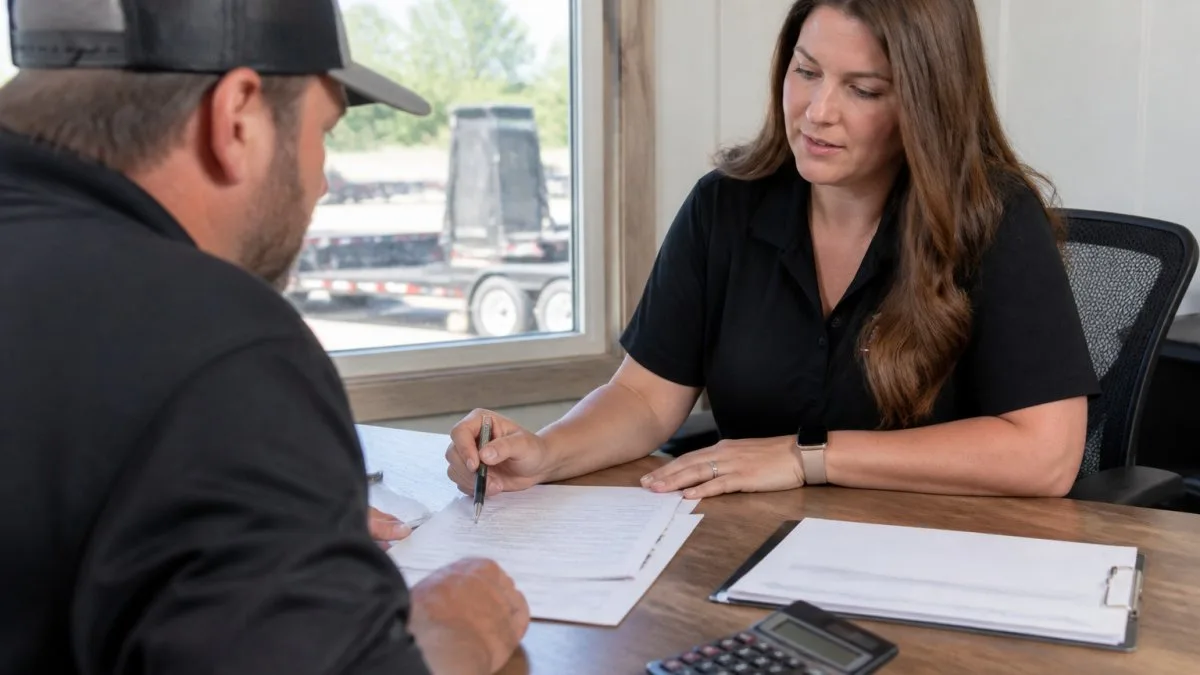
Next, complete the lender's application. Be thorough and accurate. Errors or omissions can delay approval.
The lender reviews your credit, income, and debt-to-income ratio. They assess whether your monthly income comfortably covers the proposed loan payment plus your existing obligations.
If approved, you'll receive a loan offer with specific terms: amount, rate, term, and monthly payment. Review it carefully.
Once you sign the loan agreement, the lender funds the purchase. Timing varies, but many lenders can fund within 24 to 48 hours.
The fastest approvals happen when you're organized before you apply. Have all documents ready, complete the application accurately, and be responsive to lender requests for additional information.
Total Cost of Ownership and Financing Decisions
The purchase price is just one part of the true cost. When evaluating financing options for equipment trailers, factor in the complete picture.
Interest paid over the loan term adds significantly to your cost.
Maintenance and repairs vary by trailer age and condition. New trailers typically have lower maintenance costs initially.
Insurance is mandatory. Costs depend on trailer value, type, and your business use. Factor this into your monthly operating expenses.
Depreciation matters if you plan to sell later. New trailers depreciate faster initially. Used trailers hold value more steadily.
Tax deductions may offset some costs. Loan interest and depreciation are often deductible for business use.
Compare total cost scenarios: buying outright if you have the cash, financing over different terms, or leasing.
True North Trailers and Equipment helps customers evaluate their financing options by providing flexible terms.
Securing the right financing options for equipment trailers means matching your business needs with a structure that preserves cash flow and keeps your operation running.
Frequently Asked Questions
What credit score do you need to finance an equipment trailer?
Most lenders prefer a credit score of 650 or higher for standard equipment trailer financing. However, requirements vary by lender and financing type. Some lenders work with scores as low as 550 for subprime financing, though rates will be higher. Your credit history matters as much as your score, lenders review payment patterns, existing debt, and recent inquiries. If your score is below 650, consider a co-signer, larger down payment, or exploring equipment finance agreements, which sometimes have more flexible credit criteria.
Can you finance an equipment trailer with bad credit?
Yes, equipment trailer financing for bad credit is available through specialized subprime lenders, dealer financing programs, and equipment finance agreements. Bad credit typically means a score below 600 or recent delinquencies. Expect higher interest rates (often 12-18% APR or more) and stricter terms. To improve approval odds, bring a substantial down payment (20-30%), provide proof of stable income, and consider a co-signer. Some lenders focus specifically on commercial borrowers with limited credit history, so shop multiple sources before assuming you'll be declined.
How long can you finance an equipment trailer?
Equipment trailer loans typically range from 24 to 84 months, with most falling between 36 and 60 months. Longer terms lower your monthly payment but increase total interest paid. Lease programs usually run 24 to 60 months. Equipment finance agreements vary widely based on the asset value and lender. Shorter terms (36-48 months) suit buyers planning to replace equipment sooner; longer terms (60-84 months) help with cash flow if you plan to keep the trailer for many years. Discuss term options during prequalification to find what fits your budget and business plan.
Is a personal loan or equipment loan better for buying a trailer?
Equipment trailer loans are typically better because they offer lower interest rates (secured by the trailer as collateral), longer repayment terms, and faster funding. Personal loans carry higher rates and shorter terms, making monthly payments steeper. Personal loans also don't build equipment collateral history. If you have poor credit, personal loans may be easier to obtain, but the cost is higher. For business purchases, equipment loans also provide potential tax deductions. Compare rates from both sources, but equipment financing is usually the more cost-effective choice for trailer purchases.