


Last Updated: October 28, 2026
Quick Summary
A gooseneck trailer is the better choice for heavy equipment because its hitch sits over the truck's rear axle, giving stronger stability and less sway than a bumper pull. To choose one, weigh your equipment with attachments, fuel, and tools, then compare the trailer's payload against that total.
- Weigh the machine with attachments, fuel, fluids, and tools included, not just the operating weight.
- Payload capacity equals the trailer's GVWR minus its empty weight.
- Keep the loaded trailer at or below 85-90% of GVWR as a safety margin.
- Calculate pin weight, roughly 20% of loaded trailer weight, and check it against the truck's payload.
- Verify the truck's rear axle rating, GCWR, and hitch rating, not just the advertised max tow number.
Table of Contents
- What a Gooseneck Trailer Is and How Its Hitch Works
- Gooseneck vs Bumper Pull Equipment Trailer: Which Fits Your Work
- How to Calculate Trailer Capacity for Equipment
- Gooseneck Trailer for Mini Excavator: Deck Length, Width and Ramps
- Gooseneck Trailer Towing Requirements and Tow Vehicle Checks
- Axle Configuration, Frame Strength and Build Quality
- Booking Your Gooseneck Trailer Visit at True North Trailers and Equipment
- Frequently Asked Questions
What a Gooseneck Trailer Is and How Its Hitch Works
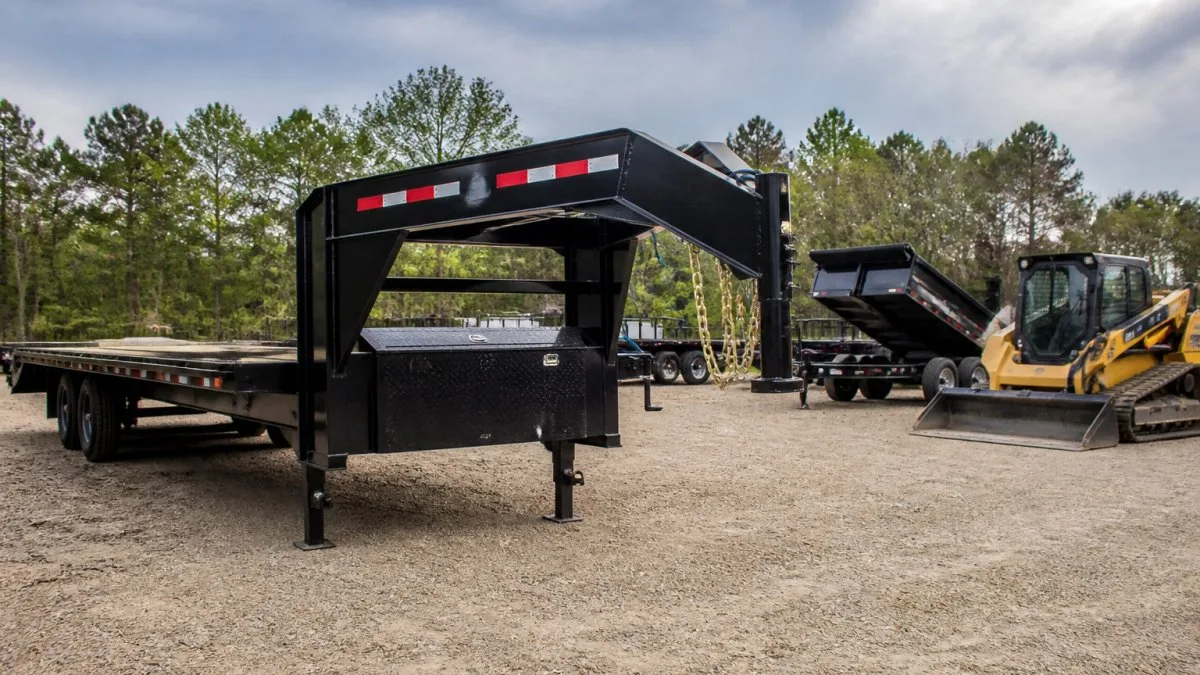
A gooseneck trailer connects to the tow vehicle through a ball-and-coupler hitch mounted over the rear axle of a pickup truck, not behind the bumper. The front of the trailer extends up and over the truck bed and rests on that hitch.
Check your truck's owner's manual for the rated gooseneck hitch capacity and maximum tongue weight.
Gooseneck vs Bumper Pull Equipment Trailer: Which Fits Your Work
A gooseneck trailer attaches over the truck's rear axle, while a bumper-pull trailer attaches to a receiver hitch behind the bumper.
Here is a quick comparison:
| Feature | Gooseneck | Bumper Pull |
|---|---|---|
| Hitch location | Truck bed, over rear axle | Receiver behind bumper |
| Load stability | Stronger, less sway | Weaker, more sway at speed |
| Typical capacity | Higher | Lower |
| Tow vehicle needs | Pickup with gooseneck hitch | Many vehicles with a receiver |
| Turning radius | Tighter | Wider |
Pros of gooseneck:
- Better stability under heavy equipment loads
- Tighter turning radius on job sites
- Higher payload capacity
Cons of gooseneck:
- Requires a truck bed hitch install
- Only usable with pickups that accept the hitch
- Heavier starting cost for the hitch
Pros of bumper pull:
- Works with more vehicles
- Easier to hitch and unhitch
- Lower upfront setup cost
Cons of bumper pull:
- More sway with heavy loads
- Lower weight capacity
- Wider turns on tight sites
How to Calculate Trailer Capacity for Equipment
The worksheet below walks through a calculation with an example.
Step 1: Weigh the equipment as it will be hauled
Start with the machine's operating weight from the spec sheet, then add everything on the deck when you tow:
- Attachments (bucket, thumb, breaker, grapple)
- Fuel and hydraulic fluid at full tanks
- Any tools, cribbing, or spare parts riding on the deck
- The operator, if the machine will be driven on and off at the destination
Step 2: Find the trailer's real payload
The trailer's GVWR (gross vehicle weight rating) is the maximum the trailer plus its load can weigh. The empty weight (sometimes called curb weight) is what the trailer weighs with no cargo. Payload capacity is the difference:
Payload capacity = GVWR − empty trailer weight
Step 3: Run a worked example
Suppose you are hauling a compact track loader and want to size a gooseneck equipment trailer:
| Item | Example weight |
|---|---|
| Machine operating weight | 8,000 lb |
| Bucket and attachment | 600 lb |
| Fuel, fluids, and tools on deck | 200 lb |
| Total cargo weight | 8,800 lb |
| Trailer GVWR | 14,000 lb |
| Trailer empty weight | 4,200 lb |
| Trailer payload capacity | 9,800 lb |
Step 4: Apply a safety margin
Many contractors keep the loaded trailer at or below 85-90% of GVWR, roughly 11,900-12,600 lb on a 14,000 lb trailer. That margin protects the axles, tires, and brakes on long grades and in summer heat, and leaves room for an extra attachment.
GVWR is not the same as the sum of the axle ratings. A trailer can be rated at 14,000 lb GVWR while its two 7,000 lb axles carry the load, but the pin weight is carried by the truck, not the axles. Always check both the GVWR and the axle ratings on the label.
Step 5: Calculate pin weight and check it against the truck
On a gooseneck, the portion of the loaded trailer weight that rests on the hitch ball is the pin weight (also called tongue weight). Using the example above:
- Loaded trailer weight: about 13,000 lb (8,800 lb cargo + 4,200 lb trailer)
- Pin weight at 20%: about 2,600 lb
That 2,600 lb comes out of the truck's payload, not the trailer's. With a 3,500 lb payload rating, two passengers, fuel, and tools in the bed can put you near the limit before the trailer is hitched.
Quick worksheet you can copy
- Machine operating weight: ______ lb
- Attachments and fluids: ______ lb
- Tools and gear on deck: ______ lb
- Total cargo (1+2+3): ______ lb
- Trailer GVWR (from label): ______ lb
- Trailer empty weight (from label): ______ lb
- Trailer payload (5−6): ______ lb
- Cargo as % of payload (4÷7): ______ %
- Loaded trailer weight (4+6): ______ lb
- Pin weight at 20% (9×0.20): ______ lb
- Truck payload rating: ______ lb
- Truck payload remaining after pin weight and cab/bed load: ______ lb
Gooseneck Trailer for Mini Excavator: Deck Length, Width and Ramps
Measure the mini excavator's length, width, and height with the boom folded and counterweight in place, then add room for ramps and tie-down points.
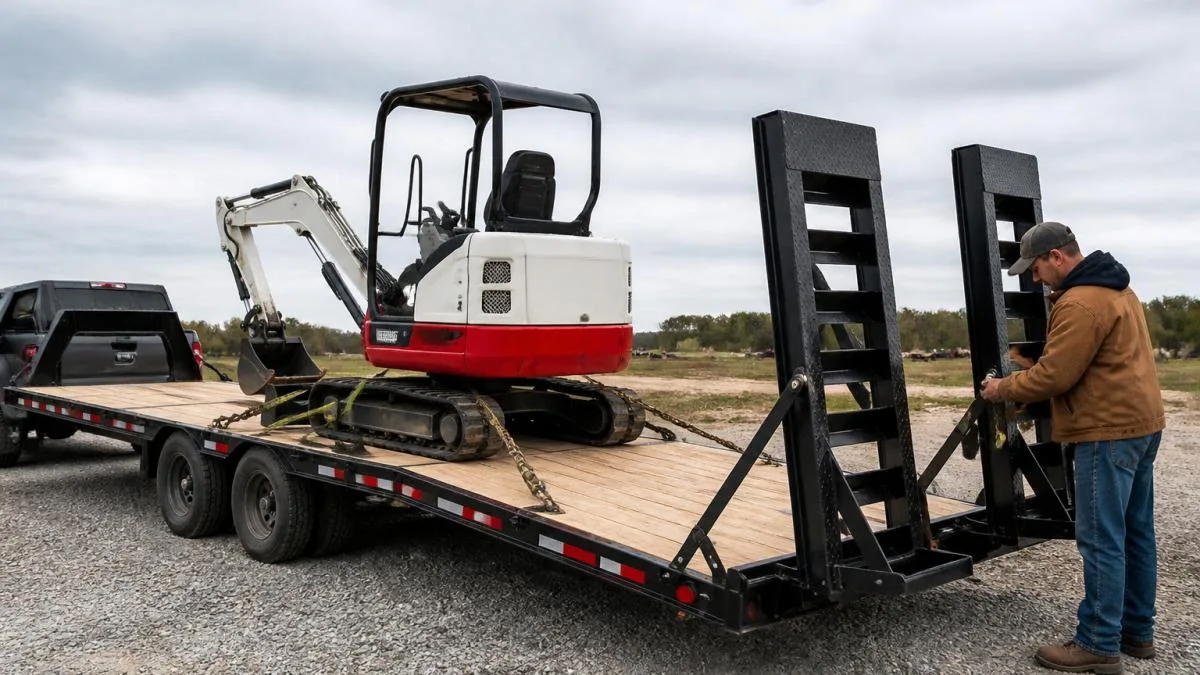
A few measurements matter most:
- Deck length: Make sure the deck is long enough to hold the machine plus a safe margin at each end. Many owners choose a deck with extra length for ramp angles.
- Deck width: Measure the track width to help assess deck width.
- Ramps: Ramps should be strong, long enough to keep the loading angle gentle, and rated for the machine's weight. Steep ramps can cause the excavator to tip or bottom out.
Gooseneck Trailer Towing Requirements and Tow Vehicle Checks
A single advertised "max tow rating" is not enough to confirm a truck can pull a loaded gooseneck. That number is usually calculated with a base truck, one driver, and no cargo, and it ignores pin weight over the rear axle. Verify five separate ratings before you buy, the lowest one is your real limit.
The five ratings that matter
1. Gross vehicle weight rating (GVWR) and payload.
2. Rear gross axle weight rating (GAWR). This is the maximum weight the rear axle can carry. Pin weight, the hitch, and anything in the bed behind the cab all land here. A truck can be under GVWR and still overload the rear axle, especially with heavy pin weight and a loaded bed.
3. Gross combined weight rating (GCWR).
4. Hitch rating.
5. Tire and wheel ratings.
How to verify each one
- Door jamb label: GVWR, GAWR front and rear, and the recommended cold tire pressures.
- Tire-and-loading label: payload for your exact truck as built.
- Owner's manual towing section: GCWR, maximum trailer weight, and the gooseneck-specific ratings.
- Hitch manufacturer's label or instructions: gross trailer weight and pin weight limits.
- Trailer certification label: GVWR, GAWR per axle, and tire size and pressure.
Pre-tow checklist
Once the ratings line up, run this check before every haul:
- Tire pressure on truck and trailer, set cold to the label specs
- Trailer brake function, including the breakaway system and the controller gain setting
- Hitch connection: ball fully seated, coupler latched, safety pin in place
- Safety chains crossed and attached to the truck's anchor points
- Trailer lights: running, brake, turn, and reverse
- Load securement: chains or straps rated for the machine, attached to the frame, with binders tightened
- Ramps stowed and latched
- Pin weight confirmed by a scale or a calculated estimate
When the numbers do not work
If the loaded trailer exceeds the truck's GCWR or the pin weight exceeds the rear GAWR, you have three options: a lighter trailer or machine, a larger truck, or splitting the load. Airbags, helper springs, and weight-distributing hitches can improve ride and stability, but they do not change the manufacturer's published limits. Contractors who haul weekly size the truck first and the trailer second, because the truck's ratings are the harder constraint to change later.
Axle Configuration, Frame Strength and Build Quality
For used trailers, inspect the frame for rust, cracks, or bent sections, and test the brakes, ramps, and gate latches. Read gooseneck trailer maintenance tips for longevity to learn how to keep the frame and build in good condition over time. A used trailer can be a good value, but it needs a careful inspection first.
Booking Your Gooseneck Trailer Visit at True North Trailers and Equipment
If you need help with payment, financing options at True North Trailers and Equipment are available to discuss. Bring your equipment's weight, dimensions, and your tow vehicle's rating so the team can help you match a trailer to your work. You can contact True North Trailers and Equipment to arrange your visit.
Frequently Asked Questions
How do I choose the right gooseneck trailer for equipment?
Start by considering the machine you plan to haul and its dimensions. Check the trailer's specifications and your tow vehicle's ratings. Visit True North Trailers and Equipment for information about its trailer inventory and flexible financing options.
What size gooseneck trailer do I need for a mini excavator?
Check the mini excavator's specifications and measure its length, width, and track or tire footprint before choosing a trailer. Confirm the machine's specifications with its manufacturer, since weights and dimensions can vary by model and configuration.
How much weight can a gooseneck equipment trailer carry?
Trailer capacity varies by model. Check the specifications for the trailer you are considering.
What is the difference between a gooseneck and a bumper-pull equipment trailer?
A gooseneck attaches to a ball in the bed of a pickup, while a bumper-pull attaches to a receiver hitch on the back of the vehicle. The right trailer depends on the equipment and tow vehicle.
