

Last Updated: October 23, 2026
Quick Summary
To finance commercial mower purchases, you can choose between dealer financing (fastest approval in 1-3 days), bank loans (lower rates but 14-28 day approval), or manufacturer promotions (sometimes zero-interest offers). Each option has different trade-offs in approval speed, interest rates, and credit flexibility.
- Dealer financing approves fastest and accommodates weaker credit, while bank financing offers lower interest rates but requires thorough documentation and 14-28 days.
- Secured loans work best for bad credit because the mower itself serves as collateral, reducing lender risk.
- Use the utilization test: rent under 200 hours yearly, lease or finance 200-600 hours yearly, and buy or finance over 600 hours yearly.
- Gather two years of tax returns, business bank statements, proof of business formation, and government ID before applying to speed approval.
- A $15,000 mower financed at 8% over five years costs roughly $3,300 in interest alone, so compare total cost across lenders before committing.
Table of Contents
- Understanding Commercial Mower Financing Options
- Commercial Mower Financing with Bad Credit
- Lawn Care Equipment Financing: Dealer vs. Bank vs. Manufacturer
- Financing vs. Buying a Commercial Mower Outright
- Mower Financing with No Down Payment
- The Application and Approval Process
- Total Cost of Ownership and Cash Flow Planning
- Frequently Asked Questions
Understanding Commercial Mower Financing Options
When you finance commercial mower equipment, it opens doors for lawn care businesses that need equipment now but lack upfront capital. Purchasing commercial-grade mowers and landscaping equipment represents a significant investment for contractors and property managers. The good news: multiple financing paths exist to fit different situations.
Equipment financing comes in several forms. Bank loans offer competitive rates but require solid credit. Dealer financing moves faster and often accommodates weaker credit profiles. Manufacturer promotions sometimes include zero-interest offers on new equipment. Each route has trade-offs worth understanding before you apply.
The key difference between these options boils down to approval speed, interest rates, and flexibility. Bank financing typically requires 20-30 days and thorough documentation. Dealer financing can close in days. Manufacturer programs may lock you into specific equipment choices.
Start by checking your credit score before you shop. Knowing your standing helps you target the right financing partner and sets realistic expectations for interest rates and down payment requirements.
Commercial Mower Financing with Bad Credit
Bad credit doesn't automatically disqualify you from financing commercial mowers. Many lenders understand that landscapers and contractors face cash flow challenges, especially during off-seasons. The path forward requires strategy.
Secured loans work best for borrowers with imperfect credit. You pledge the mower itself as collateral, which reduces the lender's risk and often results in approval despite lower credit scores. This is how most commercial equipment financing operates. The equipment secures the debt.
Dealer financing is often more flexible than traditional banks. Dealers work with multiple lenders and specialize in equipment buyers. They understand seasonal businesses and irregular income patterns. If you've been turned down by a bank, a dealer may have options.
Consider bringing a co-signer with stronger credit. This person guarantees the loan if you default. Many lenders will approve deals with co-signers that they'd reject otherwise.
Watch out for predatory terms disguised as "flexible financing." If an interest rate seems unusually high or the loan term extends beyond the equipment's useful life, walk away. You'll end up paying more in interest than the mower costs.
Lawn Care Equipment Financing: Dealer vs. Bank vs. Manufacturer
Each financing source has distinct advantages. Understanding the differences helps you choose the right fit for your business.
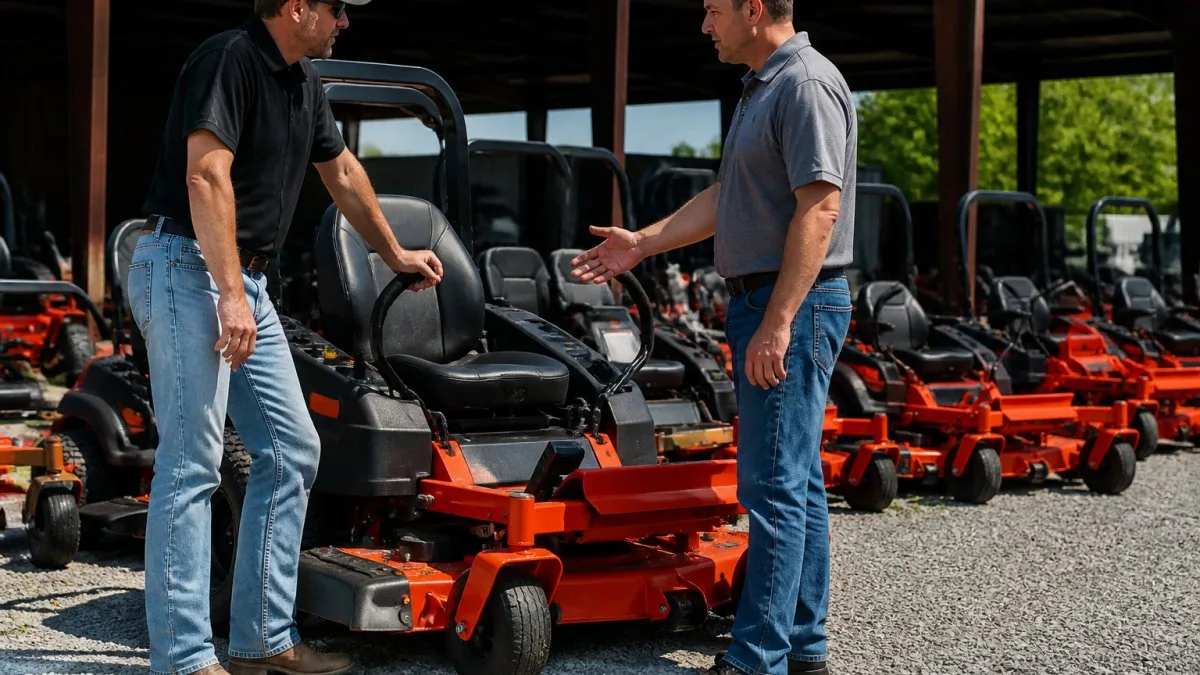
Dealer financing moves fastest. You walk in, pick your mower, and leave with approved paperwork the same day in many cases. Dealers have established relationships with multiple lenders and know which ones approve contractors with variable income.
Bank financing typically offers lower interest rates than dealers. Banks compete on rates and want your business long-term. The catch: approval takes longer (two to four weeks), and banks scrutinize your income documentation heavily. You'll need tax returns, bank statements, and proof of business registration.
Manufacturer financing occasionally includes promotional rates like zero-interest options. These programs are time-limited and apply only to specific equipment models. Manufacturer programs work well if you need a particular mower and the timing aligns with an active promotion.
| Financing Source | Approval Speed | Interest Rate | Credit Flexibility | Best For |
|---|---|---|---|---|
| Dealer | 1-3 days | Moderate to High | High | Quick purchases, weaker credit |
| Bank | 14-28 days | Low to Moderate | Moderate | Established businesses, lower rates |
| Manufacturer | 7-14 days | Low (promotional) | Moderate | Specific equipment, time-limited offers |
Financing vs. Buying a Commercial Mower Outright
The choice between financing and paying cash depends on your business cash flow and growth plans. Both approaches have merit, but the decision gets clearer when you compare all four funding routes side by side: cash purchase, equipment loan, lease, and rental.
Paying cash preserves your credit lines for emergencies. Cash purchase also simplifies accounting, you capitalize the asset and depreciate it under IRS rules (typically Modified Accelerated Cost Recovery System, or MACRS, over a 5- or 7-year recovery period for most commercial mowers, depending on classification).
Financing keeps your working capital liquid. Under IRC Section 179, you may be able to expense the full purchase price of qualifying equipment in the year it's placed in service, subject to annual limits, ask your tax advisor whether your mower qualifies (Depreciation expense helps business owners keep more money).
Leasing works best when utilization is predictable and you prefer lower monthly outlays. An operating lease keeps the mower off your balance sheet and bundles maintenance in some programs, but you build no equity and face mileage or wear charges at turn-in.
Renting makes sense for short-term demand, a one-off municipal contract, a storm-cleanup surge, or a trial before committing to a model.
Use a simple utilization test to choose:
- Under 200 hours per year: rent or lease short-term; ownership rarely pencils out.
- 200-600 hours per year: a lease or equipment loan balances cash flow and equity.
- Over 600 hours per year: financing or cash purchase usually wins because the machine is a core revenue asset.
Consider your business stage. New operations benefit from financing to preserve cash. Established businesses with strong reserves might prefer paying cash to avoid interest.
The real question isn't whether to finance or pay cash, it's whether you need the equipment now to grow revenue. If the mower will generate income that exceeds the financing cost, financing makes financial sense. Run the utilization test first, then compare the after-tax cost of each route with your accountant.
Mower Financing with No Down Payment
Zero-down financing exists but comes with conditions. Lenders offering this option typically charge higher interest rates to offset the increased risk. You're financing 100% of the equipment cost, so the lender's security is limited.
Dealer financing is most likely to offer zero-down options when you finance commercial mower purchases. Dealers know the equipment value and can structure deals where they retain security interest in the mower. If you default, they repossess and resell the equipment.
Eligibility for zero-down financing usually requires decent credit (typically 650 or higher) and proof of stable business income. Self-employed contractors sometimes struggle here because income documentation is more complex than W-2 employees face.
Alternative approach: Put down a small amount (even 10-15%) to reduce the financed amount. This improves your approval odds and lowers your monthly payment. Many borrowers find this middle ground works better than fighting for zero-down terms.
The Application and Approval Process
The financing application process follows predictable steps.
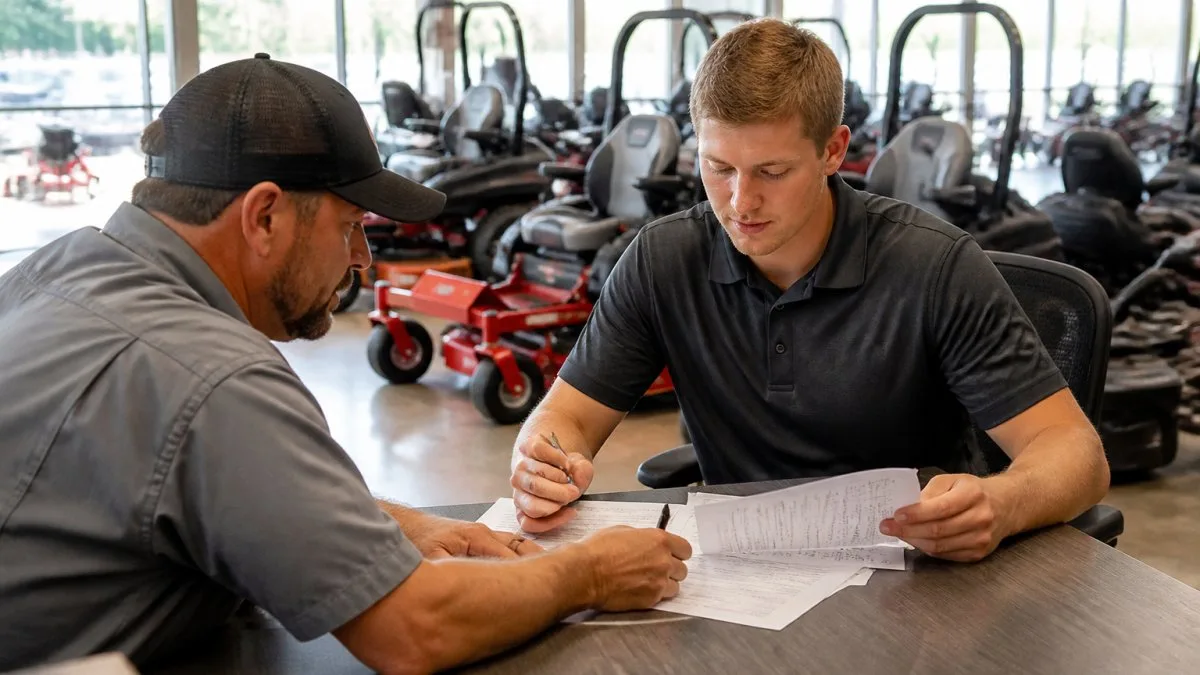
Step 1: Gather business-specific documentation. Lenders evaluating a commercial mower loan typically want more than a pay stub. Prepare:
- Two years of business tax returns (and personal returns if you're a sole proprietor or single-member LLC).
- Year-to-date profit-and-loss statement and balance sheet.
- Three to twelve months of business bank statements showing consistent deposits.
- Proof of business formation, articles of incorporation, LLC certificate, or assumed-name filing.
- A current business license and, for some lenders, proof of general liability insurance.
- A voided business check and government-issued ID for the signer.
Lenders also weigh time in business and business credit. Many bank and SBA-style programs want at least two years of operating history; dealer and online lenders are often more flexible for newer operations.
Step 2: Check your credit. Request your personal credit report from the three major bureaus (Equifax, Experian, TransUnion) and review for errors (Free Credit Reports). Dispute inaccuracies before applying. A single error can cost you approval or higher rates. Note that most commercial equipment lenders pull personal credit for sole proprietors and small LLCs, so both reports matter.
Step 3: Prequalify before you commit. Many lenders offer prequalification with a soft credit pull that doesn't affect your score.
Step 4: Compare offers on total cost, not just rate. Request the annual percentage rate (APR), which folds in origination fees, and ask for the total of payments.
Step 5: Submit your application. Provide complete, accurate information. Incomplete applications get rejected or delayed. Double-check everything before submitting, and respond quickly to underwriter requests, stalled files often lose rate locks.
Step 6: Review the contract before signing. Read every line for terms that change the real cost:
- Origination or documentation fees, often 1-5% of the loan amount.
- Deferred-interest promotions, "no interest if paid in full" offers can retroactively charge interest from the purchase date if you miss the payoff deadline.
- Prepayment penalties, some contracts charge a fee for paying off early; ask explicitly.
- Personal guarantees, most small-business equipment loans require the owner's personal guarantee, meaning your personal assets back the debt.
- Default and repossession terms, understand the cure period and what happens to the mower (and any personal assets) if you miss payments.
Step 7: Receive approval and fund. Most lenders respond within 3-7 business days; dealer programs can be same-day. Approval typically comes with specific terms: interest rate, loan amount, monthly payment, and loan term. Funds usually disburse directly to the dealer or seller, and you take possession of the mower.
Watch for deferred-interest and "same-as-cash" promotions. If you don't pay the full balance within the promotional window, interest can be applied retroactively from the original purchase date, sometimes at a rate above 20%. Read the fine print and set a payoff reminder.
Prequalification doesn't hurt your credit. Many lenders offer prequalification checks that don't trigger hard inquiries. Use prequalification to understand your approval odds before submitting a full application, and to compare offers without dinging your score multiple times.
Total Cost of Ownership and Cash Flow Planning
The true cost of a commercial mower extends beyond the purchase price. Financing adds interest, and operations add maintenance, fuel, and repairs.
Interest costs depend on the loan amount, interest rate, and term.
Maintenance and repairs vary by equipment age and usage. New mowers cost less to maintain initially. Used equipment may surprise you with unexpected repairs.
Fuel and operation costs depend on mower type and usage hours. Calculate these based on your typical service volume.
Seasonal cash flow matters for landscapers. Winter months often bring reduced work and income.
Create a simple spreadsheet: monthly loan payment plus estimated maintenance and fuel costs. Compare this total to your average monthly revenue from the mower's work.
Financing a commercial mower through True North Trailers and Equipment gives you access to quality equipment without depleting your operating capital.
Frequently Asked Questions
How does financing a commercial mower work?
Commercial mower financing works similarly to auto loans. You borrow money from a lender (dealer, bank, or manufacturer), agree to repay it over a set term (typically 24-60 months), and pay interest. The mower serves as collateral. Monthly payments depend on the loan amount, interest rate, and term length. You own the equipment immediately and can use it for your business while paying it off.
Can I finance a commercial mower with bad credit?
Yes. Dealers, some equipment-specific lenders, and buy-now-pay-later platforms often work with borrowers who have imperfect credit. Expect higher interest rates and stricter terms. Secured loans (where the mower is collateral) are easier to qualify for than unsecured options. A larger down payment or co-signer can improve your chances. Compare offers from multiple lenders before applying.
What's the difference between financing and leasing a commercial mower?
Financing means you borrow money to buy and own the equipment; you build equity and can sell it later. Leasing means you rent the equipment for a fixed term and return it. Financing suits operators who keep equipment long-term and want to customize it. Leasing works for seasonal businesses or those wanting lower upfront costs and predictable monthly expenses. Financing typically costs more overall but gives you ownership and tax deductions.
Can I finance a commercial mower with no money down?
Yes, many dealers and lenders offer zero-down financing, especially on new equipment or with promotional rates. No-down options usually mean higher monthly payments and interest rates to offset lender risk. Your credit score, business revenue, and equipment type affect approval odds. Ask about promotional 0% interest offers, which sometimes waive down payments for qualified buyers. Always compare total financing costs, not just the down payment.
