

Table of Contents
- What Makes a Gooseneck Trailer Suitable for Construction
- Gooseneck Equipment Trailers: Deck Styles and Configurations
- Gooseneck Trailer Capacity: Matching Load to Equipment
- Top Gooseneck Trailer Models for Construction Work
- 40 ft Gooseneck Trailer CDL Requirements and Legal Considerations
- Gooseneck Flatbed Trailers for Construction Equipment
- How to Choose the Right Gooseneck Trailer for Your Job
- Frequently Asked Questions
Last Updated: October 14, 2026
What Makes a Gooseneck Trailer Suitable for Construction
The wrong gooseneck trailer becomes a liability when hauling construction equipment. The best gooseneck trailers construction combines weight capacity, deck design, and hitch stability. At True North Trailers and Equipment, we help contractors match trailers to their loads and tow vehicles.
The gooseneck design, where the hitch connects above the rear axles rather than at the bumper, distributes weight more evenly and improves towing stability on rough terrain. But capacity alone doesn't make a construction trailer reliable, you also need the right deck configuration, axle rating, and braking system.
GVWR and Payload Capacity
Gross Vehicle Weight Rating (GVWR) is the maximum safe weight your trailer can carry, including the trailer itself. A 14,000-pound GVWR means trailer plus load cannot exceed that figure. Overloading damages axles, tires, and brakes and can get you cited.
Payload capacity is what's left after subtracting the trailer's dry weight from its GVWR. A 4,000-pound trailer with a 14,000-pound GVWR gives you 10,000 pounds of payload.
That extra capacity matters when stacking multiple machines or adding fuel, tools, and materials.
Deck Design and Load Distribution
How weight sits on the deck affects stability and tire wear. A flatbed gooseneck distributes loads evenly, which works well for compact equipment. A deck-over shifts weight slightly rearward, preferred by some for taller equipment.
Steel diamond plate provides grip in wet conditions but adds weight; treated wood decks are lighter and easier on equipment paint but require maintenance.
Weight distribution also depends on axle placement. Tandem axles spread the load across more tire contact points, reducing ground pressure and extending tire life.
Gooseneck Equipment Trailers: Deck Styles and Configurations
Construction equipment demands different deck styles depending on what you're moving.
Flatbed vs. Deck-Over vs. Straight Deck
A flatbed gooseneck has a level deck surface from hitch to rear, with no raised edges.
Deck-over trailers raise the deck above the frame rails, creating storage space underneath. This adds structural strength and keeps the center of gravity lower, improving handling. Deck-overs work well for heavy single items like a large excavator.
Straight-deck trailers keep the load platform low and close to the frame. Straight decks reduce the distance from hitch to load and decrease sway on curves or in wind.
Tilt Deck Options for Easy Loading
A tilt deck lowers hydraulically to ground level, letting you drive equipment on without ramps. This saves time and reduces slipping risk. If you move equipment multiple times per week, a tilt deck cuts setup time from 20 minutes to 5 minutes.
The trade-off is weight and complexity. Tilt decks add hydraulic systems and frame reinforcement that reduce payload capacity, a 14,000-pound GVWR tilt deck might only carry 9,000 pounds. For regular hauling, a tilt deck justifies the cost; for occasional moves, a fixed flatbed and ramps make more sense.
Gooseneck Trailer Capacity: Matching Load to Equipment
Capacity numbers mean nothing if they don't match your actual equipment. Buying a 14,000-pound-rated trailer for 8,000 pounds of equipment means paying for capacity you'll never use and adding weight that reduces fuel efficiency.
Weigh your heaviest piece of equipment on a truck scale, add 15% for fuel, hydraulic fluid, and attachments, then add 1,000 pounds for tools and supplies. That total is your minimum GVWR requirement.
Engineered beams cost more upfront but deliver better payload efficiency over the trailer's life.
Axles, Braking Systems, and Weight Distribution
Axle rating determines how much weight each axle can safely support. A tandem-axle setup with two 7,000-pound axles gives you 14,000 pounds total capacity. A single 10,000-pound axle is lighter and cheaper but limits payload.
Braking systems must match your tow vehicle and trailer weight.
Weight distribution between tow vehicle and trailer affects handling and tire wear. Hitch pin weight should be 10-15% of total loaded trailer weight, a 12,000-pound loaded trailer needs 1,200-1,800 pounds of pin weight.
Top Gooseneck Trailer Models for Construction Work
We carry models that handle real construction demands.
1. MAXX-D GSB10240: Straight-Deck Workhorse
Some straight-deck configurations keep loads low and centered, reducing sway on uneven terrain, with no complex tilt mechanisms to maintain.
This type of trailer suits contractors hauling equipment under 8,000 pounds regularly, skid steers, small compactors, and tool carts fit comfortably. Its competitive pricing makes it ideal for small operations or contractors expanding their fleet without major capital investment.
Straight-deck trailers perform best when you load equipment toward the front of the deck. This positioning improves weight distribution and reduces the use that causes sway during turns.
2. MAXX-D GSX10240: Heavy-Duty Mid-Range
Some heavy-duty models handle larger excavators, wheel loaders, or multiple pieces of equipment on one haul. Our competitive pricing makes it the balance point for many contractors.
This type of trailer works best for crews that move varied equipment, some light, some heavy, and need flexibility without overloading. A higher GVWR provides that buffer without tilt deck complexity or engineered-beam pricing.
A 14,000-pound GVWR doesn't mean you should load 14,000 pounds on every haul. Consistently running near maximum capacity accelerates tire wear and strains braking systems. Aim to keep loads at 70-80% of rated capacity for longer equipment life.
3. Big Tex Flatbed Gooseneck: Oversized Equipment Specialist
Flatbed goosenecks are engineered for oversized loads, large dozers, motor graders, or multiple pieces of equipment stacked on one trailer.
This type of trailer excels when you're moving equipment too large or heavy for standard trailers. Contractors in site preparation, earthmoving, or infrastructure work find the extra capacity justifies the investment, and the gooseneck hitch improves weight distribution when hauling a 10,000-pound dozer at highway speeds.
4. Diamond C Engineered-Beam Gooseneck: Strength-to-Weight Leader
Engineered-beam trailers reduce structural weight while maintaining capacity, using high-strength steel in strategic locations to cut unnecessary frame weight. That savings translates directly to more payload capacity without increasing GVWR.
This type of trailer suits contractors who run tight margins and need maximum efficiency, lighter trailers improve fuel economy on long hauls.
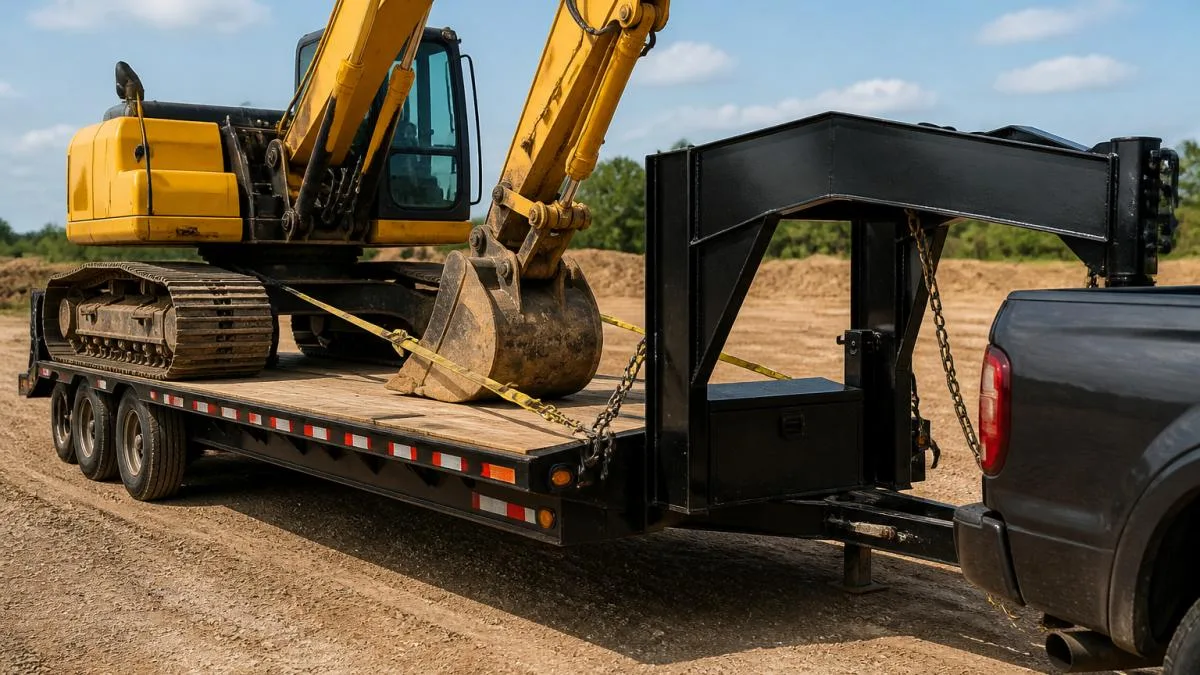
5. Kaufman Heavy-Duty Gooseneck: Durable Construction Frame
Some gooseneck trailers prioritize build quality and durability over specialized features. Their construction frames use traditional welding and proven designs that have handled construction work for decades, delivering consistent performance for contractors who value simplicity and reliability.
The heavy-duty frame means you can push these trailers hard without premature fatigue or frame cracking. For contractors running equipment 5-6 days per week in rough conditions, that durability pays off over the trailer's lifespan.
| Model | GVWR | Deck Style | Best For |
|---|---|---|---|
| MAXX-D GSB10240 | 12,000 lbs | Straight Deck | Small equipment under 8,000 lbs |
| MAXX-D GSX10240 | 14,000 lbs | Straight Deck | Mixed loads, mid-range capacity |
| Big Tex Flatbed | 16,000+ lbs | Flatbed/Deck-Over | Oversized equipment, heavy single items |
| Diamond C Engineered-Beam | 14,000 lbs | Deck-Over | Maximum payload efficiency |
| Kaufman Heavy-Duty | 14,000 lbs | Straight/Flatbed | Long-term durability, rough use |
40 ft Gooseneck Trailer CDL Requirements and Legal Considerations
A 40-foot gooseneck trailer crosses into Commercial Driver's License (CDL) territory in most states. The threshold varies, but generally if your loaded trailer exceeds 10,000 pounds GVWR, you need a CDL.
Before buying a 40-foot gooseneck, confirm your state's CDL requirements. Operating a heavy trailer without one exposes you to fines, liability issues, and denied insurance claims.
Weight limits also apply per axle and per state. Federal limits cap tandem axles at 34,000 pounds, but states may enforce lower limits on state roads.
Gooseneck Flatbed Trailers for Construction Equipment
Flatbed gooseneck trailers are the construction standard because they accommodate irregular equipment shapes and allow easy loading without ramps.
Why Flatbed Goosenecks Excel at Construction Hauling
A flatbed gooseneck provides an open, level surface that works for nearly any equipment, skid steers, mini excavators, compactors, and stacked materials fit on a single haul, with no deck edges or raised platforms to complicate loading.
The gooseneck hitch setup improves towing stability compared to bumper-pull trailers.
Flatbed trailers also simplify maintenance, no complex hydraulic tilt systems or electrical components to fail. A steel frame, wood or diamond plate deck, and basic braking system are all you need, meaning lower repair costs and less downtime.
Tie-Down Points and Loading Ramps
Proper tie-downs prevent equipment from shifting during transport. A flatbed gooseneck should have multiple D-ring or chain attachment points spaced across the deck, at least four for a single piece of equipment, one at each corner, to prevent rotation and sliding.
Loading ramps are essential unless you have a tilt deck. A pair of 8-foot ramps rated for your equipment weight lets you drive on safely; they should have a non-slip surface and be stored on the trailer.
When loading equipment with tracks (like mini excavators), position the ramps perpendicular to the deck and load slowly. Tracks can slip on smooth ramp surfaces if you accelerate too quickly. A slight angle (10-15 degrees) and slow speed prevent accidents and equipment damage.
How to Choose the Right Gooseneck Trailer for Your Job
The best gooseneck trailer for construction depends on your specific equipment, tow vehicle, and job demands. The wrong choice costs money through overloading, underutilization, or breakdowns that delay projects.
Matching Trailer Specs to Your Equipment and Tow Vehicle
List every piece of equipment you'll haul in the next 3-5 years, weigh the heaviest item, and add fuel, fluids, and attachments. That's your minimum payload requirement.
Next, verify your tow vehicle can handle the trailer.
Check hitch compatibility. A gooseneck trailer requires a gooseneck hitch mounted in your truck bed, rated for the trailer's loaded weight, a 14,000-pound GVWR trailer needs a hitch rated for at least 14,000 pounds.
Build Quality, Durability, and Long-Term Value
Price is important, but the cheapest trailer often becomes the most expensive when repairs start.
Look for rust-resistant paint, solid welds without gaps or cracks, and brakes that are easy to service. Talk to contractors who own the model you're considering and ask about common problems and repair costs.
Warranty coverage matters too. A manufacturer warranty covering frame defects for 3-5 years provides some protection, but warranties don't cover wear items like tires, brakes, and lights. Factor annual maintenance costs into your total cost of ownership.
Choosing the right gooseneck trailer for construction requires matching capacity to your equipment, understanding weight distribution, and selecting build quality that lasts. Visit True North Trailers and Equipment to discuss your equipment and tow vehicle, explore flexible financing options, and find the trailer that keeps your crew productive without overloading your budget.
Frequently Asked Questions
Does a 40-foot gooseneck trailer require a CDL?
A 40-foot gooseneck trailer requires a CDL if the combined gross vehicle weight rating (GVWR) of the tow vehicle and trailer exceeds 26,001 pounds. Most construction-grade 40-foot goosenecks fall into this category. Check your trailer's GVWR and your tow vehicle's specifications to confirm whether you need a CDL for your specific setup.
What gooseneck trailer capacity do I need for construction equipment?
Capacity depends on what you're hauling. A 12,000-pound GVWR trailer suits smaller equipment like compact excavators or skid steers. For mid-size dozers or loaders, look for 14,000-16,000 pounds GVWR. Large construction equipment may require tandem-axle goosenecks rated 20,000 pounds or higher. Weigh your heaviest load and add 20% for safety, then match that to the trailer's payload capacity.
Is a flatbed or deck-over gooseneck better for construction equipment?
Flatbed goosenecks offer a completely open deck ideal for oversized or irregularly shaped equipment and provide maximum tie-down flexibility. Deck-over trailers have a slightly raised deck that clears the gooseneck hitch, offering good clearance for tall loads. For most construction hauling, flatbeds are preferred because they accommodate heavier equipment and allow easier loading with ramps. Deck-overs work well for lighter equipment where ground clearance matters less.
What should I look for in a gooseneck equipment trailer?
Prioritize GVWR and payload capacity matched to your equipment weight. Check the deck material (treated wood or steel), axle rating, and braking system type (electric or hydraulic). Verify hitch pin weight capacity and weight distribution design to ensure towing stability. Look for quality paint and frame construction to resist rust and corrosion. Ensure tie-down points are adequate and spaced for your typical loads. Finally, confirm the trailer is available in stock and backed by dealer support.