

Table of Contents
- Why Buy Trailers From Local Dealers
- What to Look for When Buying a Trailer
- How to Choose the Right Trailer for Your Needs
- Questions to Ask a Trailer Dealer Before You Buy
- Trailer Financing Options and Cost of Ownership
- Local Dealer Advantages: Warranty, Service, and Inspection
- New Versus Used Trailers: Making the Right Choice
- Frequently Asked Questions
Last Updated: October 14, 2026
Why Buy Trailers From Local Dealers
When you're shopping for a trailer, understanding why buy trailers from local dealers versus online sellers shapes everything that comes next. The reasons to buy trailers from local dealers go far beyond convenience: immediate access to inventory, hands-on inspection, expert guidance, and ongoing support.
The local dealer advantage isn't just about location. It's about having someone who knows your equipment and stands behind what they sell.
What to Look for When Buying a Trailer
Before you step onto a dealership lot, know what matters. The right trailer depends on a few concrete factors.
Trailer Type and Intended Use
Your first decision is simple: what will you haul? Choosing the wrong trailer type wastes money and creates operational friction.
Utility trailers are the workhorses for most small operations: open, easier to load, lighter than enclosed alternatives, and cheaper upfront.
Enclosed trailers provide weather protection and security for expensive equipment or merchandise that needs to stay dry.
Match trailer type to what you actually haul, not what sounds impressive.
Load Capacity and Specifications
Every trailer has a payload capacity, the maximum weight it can safely carry. Exceed it and you risk equipment failure, safety issues, and liability.
Start with your tow vehicle's towing capacity.
Next, calculate the weight of what you'll haul, and be honest about worst-case scenarios. Hauling landscaping equipment? Add the mower, trimmer, fuel, and operator.
Axle configuration matters too. Single-axle trailers work for lighter loads and shorter distances.
How to Choose the Right Trailer for Your Needs
Choosing the right trailer requires honest assessment of three things: what you haul, how often, and what you can afford.
Start by listing the jobs you'll use the trailer for over the next three to five years, and think about growth.
Next, talk to other operators in your field. What do they use, and what do they wish they'd bought instead?
Finally, visit the dealership in person.
Questions to Ask a Trailer Dealer Before You Buy
The right questions separate dealers who know their business from those who just want to move inventory.
What's the warranty, and what does it cover? Get the details in writing: does it cover structural welds, axles, and brakes?
If something breaks, how long until I get it fixed? This matters most when equipment fails during a job.
What financing options do you offer? Local dealers often have more flexibility than online sellers.
Trailer Financing Options and Cost of Ownership
The sticker price is the smallest part of the decision. The real question is total cost of ownership, where a local dealer and an online or private seller diverge in ways that are easy to miss until after the sale.
Local dealer vs. online or out-of-area seller: the cost comparison
| Cost factor | Local dealer | Online / out-of-area seller |
|---|---|---|
| Purchase price | Often competitive; negotiable in person | Sometimes lower list price |
| Delivery | Pick up on the lot, or local delivery | Freight or a long drive to collect |
| Inspection before payment | In person, on your schedule | Photos and video only |
| Registration and title paperwork | Dealer typically handles or guides it | You handle it, often across state lines |
| Warranty claim filing | Dealer files and performs labor | You coordinate with manufacturers |
| Parts and service | Local, same-day or short turnaround | You source parts and find a shop |
| Resale | Local buyer pool, dealer trade-in possible | Same as any private sale |
The list price on an online listing can look lower, but add freight, a trip to collect the trailer, time to sort out an out-of-state title, and labor to find a shop willing to service a unit they did not sell. The gap narrows fast. For a used trailer from a private seller, add the cost of a pre-purchase inspection you arrange and pay for yourself.
Financing: what to expect
Trailer financing generally falls into three buckets: manufacturer-backed programs through the dealer, dealer-arranged lending through a bank or credit union, and direct lending you arrange yourself.
A local dealer can often run your application through more than one lender and explain the trade-offs between a lower rate with a shorter term and a higher rate with a longer one. Ask for the APR, term length, down payment, and whether there is a prepayment penalty, and get the numbers in writing.
If you have a relationship with a credit union, get a pre-approval before you visit the lot. It gives you a rate to compare against the dealer's offer and a firm budget to shop within.
Registration, title, and insurance
Registration and titling rules for trailers are set at the state level and vary. Some states title trailers above a certain weight; others register by gross vehicle weight rating (GVWR) and issue a plate.
Insurance is usually handled through your auto policy as an add-on, but a trailer with significant value or commercial use may need its own policy. Get a quote before you buy so the premium is part of your budget, not a surprise.
Maintenance and resale
Budget for wear items on a schedule: tires age out in roughly five to seven years regardless of tread, wheel bearings need periodic repacking or replacement, and brakes, seals, and lights are consumables. A local dealer can give you realistic intervals and costs.
Resale value favors trailers that were maintained and documented. A trailer with service records, a clean title, and a known history sells faster and for more than one with an unknown past.
| Cost Component | Typical Consideration | Why It Matters |
|---|---|---|
| Purchase price | Varies by type and specs | Initial investment |
| Financing | APR, term, down payment, prepayment penalty | Affects monthly cash flow and total interest |
| Delivery | Local pickup vs. freight or travel | Often erases an online price advantage |
| Maintenance | Tires, brakes, bearings, seals | Ongoing operational cost |
| Registration and title | State weight thresholds and fees | Regulatory requirement; varies by state |
| Insurance | Coverage type and trailer value | Liability and asset protection |
| Repairs | Parts and labor if damage occurs | Lower with a local service relationship |
Compare total cost, not list price. Add delivery, title and registration, inspection, and the value of local service to the sticker, then decide which seller actually costs less over the life of the trailer.
Local Dealer Advantages: Warranty, Service, and Inspection
Most trailer-buying articles stop at "buy local for service." That advice is useless unless you know what service actually looks like when a trailer fails mid-job.
What a warranty claim actually involves
Trailer warranties are typically split into component coverage rather than one blanket promise. The frame and structural welds are usually covered by the trailer manufacturer; axles, brakes, and suspension components are often covered by their own manufacturers (common names include Dexter and Lippert); tires are almost always covered by the tire maker, not the trailer brand; and lights and wiring may be covered for a short window only.
That split matters because a local dealer files the claim, orders the replacement part, and does the labor. Buy from an online or out-of-area seller and you're usually the one calling three manufacturers, shipping a failed axle back on your own dime, and finding a shop willing to install a part they did not sell. Ask the dealer, in writing:
- Which components are covered, by whom, and for how long
- Who pays labor, and at what rate
- Whether the claim is filed by the dealer or by you
A verbal "it's covered" is not a warranty term. Ask for the manufacturer's written warranty document before you sign, and confirm the dealer's own labor policy separately.
Parts availability and turnaround
Common wear items, bearings, seals, brake assemblies, leaf springs, couplers, and LED lighting, fail first. A dealer who stocks them locally can often complete a repair the same day or within a couple of days; one who orders from a warehouse adds shipping time on top of shop scheduling.
Ask specifically: "Which of these do you keep on the shelf, and what is your typical turnaround for a brake job or a bearing replacement?" A vague answer is information.
The inspection checklist to run before you buy
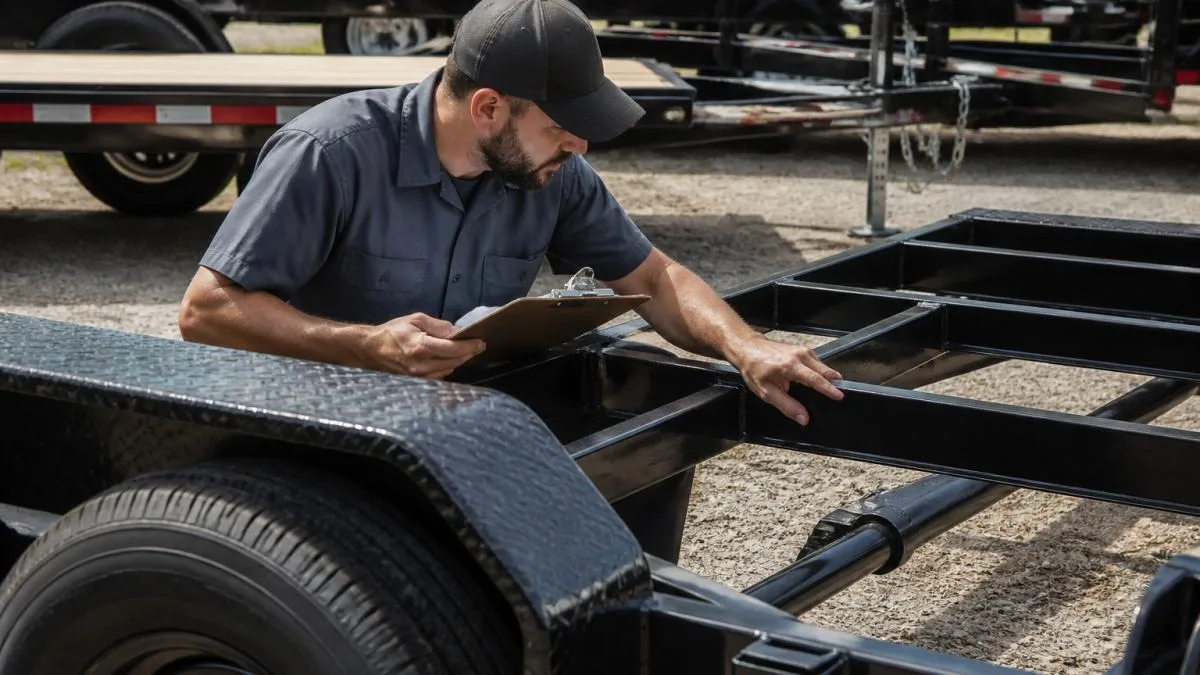
Whether the trailer is new or used, inspect it the same way. Bring a flashlight and a tire gauge.
- Frame and welds: Look for continuous, uniform welds at the tongue, crossmembers, and axle mounts. Cracks, rust-through, or lumpy, porous welds are disqualifying.
- Tires: Check date codes (the four-digit DOT stamp, the last two digits are the year). Trailer tires age out even with good tread. Look for uneven wear that signals an axle or alignment problem.
- Brakes: Confirm the trailer has brakes if its gross vehicle weight rating (GVWR) requires them, and test that the breakaway system and battery are functional.
- Lights and wiring: Test every function, running lights, brake lights, turn signals, and reverse if equipped. Inspect the connector and look for spliced or taped wiring, which suggests a repair.
- VIN and title: Match the VIN plate on the frame to the title and to any bill of sale. A mismatched or missing VIN is a title problem you do not want to inherit.
- Load rating: Confirm the GVWR and payload rating on the certification label match what you were quoted and what your tow vehicle can handle.
Why the inspection is easier at a local dealer
You can inspect a trailer from a private seller too, but you're inspecting it alone, with no recourse if you miss something. At a dealership, you can ask the service manager to walk the unit with you, request the repair history on a used trailer, and get the inspection documented on the bill of sale, documentation you rely on if a warranty dispute arises later.
The warranty is only as good as the party who files the claim and stocks the part. Before you buy, get the coverage terms in writing, confirm which wear parts are on the shelf, and document the trailer's condition at purchase.
New Versus Used Trailers: Making the Right Choice
The new-versus-used decision comes down to budget, risk tolerance, and how long you plan to keep the trailer.
New trailers come with a full warranty, no hidden damage, and the latest features, and you know the maintenance history because there isn't one yet.
Used trailers cost less but come with uncertainty: you don't know how the previous owner maintained it or what repairs might be lurking, and the warranty is shorter or nonexistent.
If you go used, inspection becomes critical.
Frequently Asked Questions
What are the benefits of buying a trailer from a local dealer?
Local dealers provide hands-on inspection before purchase, immediate access to after-sales service and repairs, personalized guidance on choosing the right trailer for your specific hauling needs, and the ability to verify inventory in person. You also gain a relationship with professionals who understand your local regulations and can help with warranty claims and parts availability without shipping delays.
What should I ask a trailer dealer before I buy?
Ask about the trailer's payload capacity, axle configuration, warranty coverage (duration and what it covers), availability of replacement parts, service turnaround time, financing terms, and whether the dealer can help with title and registration requirements. Request a full inspection and ask about any recalls or known issues with that model. Clarify the dealer's policy on post-purchase support and repairs.
Is it better to buy a trailer from a local dealer or online?
Local dealers offer inspection, immediate customer service, warranty support, and expert guidance that online sellers cannot provide. While online prices may appear competitive, local dealers provide long-term value through accessible repairs, parts availability, and professional advice. For commercial and heavy-duty needs, a local dealer relationship protects your investment and keeps your equipment operational when you need it.
What should I know before buying a trailer?
Understand your hauling requirements, tow vehicle capacity, local regulations for trailer registration and licensing, desired trailer type (utility, enclosed, gooseneck, dump), and your budget including financing costs. Verify the trailer's load capacity matches your cargo weight, check the condition of brakes and axles, and confirm warranty terms. Plan for ongoing maintenance and have a dealer relationship in place for future service needs.
Buying a trailer from a local dealer means having a partner who understands your operation and stands behind the equipment. True North Trailers and Equipment offers a diverse inventory of gooseneck, dump, car hauler, and utility trailers, backed by competitive pricing, flexible financing, and the service you need when something goes wrong. When you're ready to find the right trailer for your business, visit us and let our team help you make the choice that works.