

Last Updated: October 29, 2026
Quick Summary
The best atv and motorcycle trailer is usually a utility trailer with a deck around 12 to 14 feet long and 6.5 to 7 feet wide. Add the curb weights of both vehicles plus gear, then keep the load under about 80 to 85% of the trailer's rated payload. An enclosed model suits valuable street bikes, while an open one is cheaper and easier to tow.
- Use roughly 80 to 85% of the trailer's rated payload to leave margin for tongue weight.
- A single ATV fits a 6x10 deck, while an ATV plus motorcycle needs about 12 to 14 feet.
- Tongue weight should be about 10 to 15% of the loaded trailer weight.
- Choose enclosed for weather and theft protection, or open for lower cost and easier towing.
- Strap ATVs to the frame or tie-down points, never the handlebars or plastic bodywork.
Table of Contents
- How We Evaluated Trailers for ATVs and Motorcycles
- Quick Comparison: Top Trailer Options at a Glance
- ATV Trailer Size and Weight Capacity You Need
- Open vs. Enclosed Motorcycle Trailer: Which Fits Your Use
- How to Secure an ATV on a Trailer Safely
- Motorcycle Trailer Tie-Down Points and Load Securement
- Choosing the Right Trailer for Your Hauling Needs
- Frequently Asked Questions
How We Evaluated Trailers for ATVs and Motorcycles
Choosing an atv and motorcycle trailer comes down to fit, capacity, and how you plan to load. A good trailer should handle both vehicles, not just one. A trailer that suits a dirt bike can still be a poor match for a heavier four-wheeler, so the evaluation has to cover both.
A thorough review of a trailer should consider deck size, rated load capacity, construction, and how easily each vehicle can be secured. Ramp access and how the trailer behaves behind a tow vehicle also matter.
What we checked:
- Deck length and width against typical ATV and motorcycle footprints
- Rated payload and the weight of the vehicles you plan to carry
- Steel versus aluminum construction for durability and corrosion resistance
- Tie-down points and load securement options
- Ramp and loading access, including tilt-deck designs
Quick Comparison: Top Trailer Options at a Glance
Several trailer types suit mixed ATV and motorcycle hauling. The right pick depends on how many vehicles you carry and how much protection you need from weather.
| Trailer Type | Best For | Key Strength | Main Limitation |
|---|---|---|---|
| Open utility trailer (6x12) | Two ATVs or motorcycles | Versatile, lower cost | Exposed to weather |
| Larger utility trailer (7x16) | Multiple vehicles | Extra deck space | Heavier to tow |
| Enclosed trailer | Protecting valuable bikes | Weather protection | Higher cost and weight |
| Folding motorcycle trailer | Single or few motorcycles | Compact storage | Limited ATV fit |
Browse our Trailers For Sale in Louisiana area to see current inventory.
ATV Trailer Size and Weight Capacity You Need
Size and capacity are the first things to get right. Start with the combined weight of everything you plan to haul, then add a safety margin. Overloading can cause trailer failure on the road and can put your tow vehicle outside its ratings.
Do the weight math before you shop
Work the numbers in this order:
- Curb weight of each vehicle. A typical utility ATV runs roughly 600-800 lb; a sport quad closer to 400 lb; a full-size 4x4 ATV with a winch and accessories can push past 900 lb. A dirt bike is usually 220-260 lb, and a cruiser or adventure bike can run 500-850 lb. Use the manufacturer's curb weight, and add the weight of fuel, gear, and any accessories you have bolted on.
- Cargo and gear. Fuel cans, ramps, coolers, and tie-downs add up fast, budget 100-200 lb for a two-vehicle load.
- Trailer empty weight. A 6x12 open utility trailer is often 700-1,000 lb empty; an enclosed 7x14 can be 2,000-2,800 lb empty. This counts against your tow vehicle's ratings, not the trailer's payload.
- Payload ceiling. The trailer's rated payload is GVWR minus empty weight. That sticker number is the ceiling, not the target, plan to use no more than about 80-85% of it so you have margin for tongue weight, road forces, and uneven loading.
- Tow vehicle ratings. Check the hitch rating, the vehicle's gross trailer weight rating, and its tongue-weight rating. Tongue weight should land around 10-15% of the loaded trailer weight; too little causes sway, too much unloads the front axle and hurts steering.
A quick sanity check: add the curb weights of both vehicles, add gear weight, and compare that total to the trailer's payload.
Deck size for ATVs and motorcycles
Deck dimensions matter as much as payload, because a trailer that is rated for the weight can still be too short or too narrow to load safely.
- Single ATV: a 6-foot-wide by 10-foot-long deck is often enough, but check the ATV's overall length (many are 6.5-7.5 ft long) and its width at the tires (typically 45-50 in). You want at least 6-12 in of clearance front and rear for strap access.
- Two ATVs side by side: usually a 12-foot or longer deck at 6.5-7 feet wide. Measure the combined tire width plus 12 in between the machines.
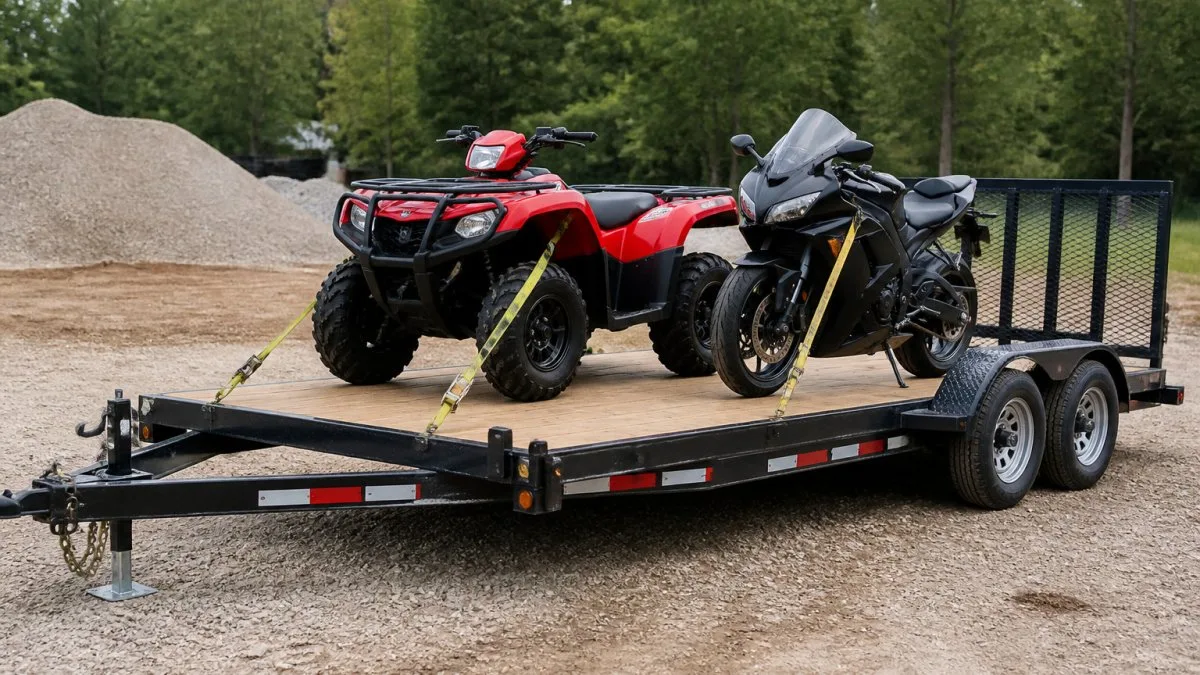
- ATV plus motorcycle: a 12- to 14-foot deck at 6.5-7 feet wide works if you stagger the load, ATV forward on one side, bike behind it on the other, or run them nose-to-tail on a 14-foot deck. Watch handlebar width: cruiser bars can run 32-36 in, wider than many ATV bars.
- Two motorcycles: a 10- to 12-foot deck at 6 feet wide is common; add a wheel chock for each bike.
Single axle vs. tandem axle
A single-axle trailer is lighter and easier to maneuver, but it has less reserve capacity and less stability if a tire fails. Tandem axles spread the load and can provide added stability if a tire fails, at the cost of extra weight and more tire maintenance. For a mixed ATV and motorcycle load that approaches 2,500 lb or more, tandem axles are the safer default.
Match the trailer to the tow vehicle
Confirm the rated payload, then confirm your tow vehicle can pull the loaded trailer, not just the empty one. A mid-size truck or SUV rated to 5,000 lb can usually handle a loaded 6x12 open trailer with one ATV and one bike; a 7x16 enclosed trailer loaded with two ATVs will often exceed that and call for a full-size truck. Plan for the weight of gear you add later, and leave headroom rather than towing at the limit.
Open vs. Enclosed Motorcycle Trailer: Which Fits Your Use
Most roundups split ATV trailers and motorcycle trailers into separate lists. That is a problem if you own both, because the trailer that is ideal for one is rarely ideal for the other. This section compares open and enclosed designs specifically for a mixed load, and it is the decision most buyers get wrong.
The real trade-offs, side by side
| Factor | Open trailer | Enclosed trailer |
|---|---|---|
| Purchase price | Lower | Higher, often two to three times an open trailer of similar deck size |
| Empty weight | 700-1,000 lb for a 6x12 | 2,000-2,800 lb for a 7x14 |
| Towing behavior | Lighter, easier on the tow vehicle, more affected by crosswinds when empty | Heavier, more stable loaded, more wind resistance and worse fuel economy |
| Weather and theft protection | None, bikes and ATVs are exposed | Full enclosure with lockable doors |
| Loading | Ramp or tilt deck, easy to see the load | Ramp through a rear door; tighter overhead clearance, especially for tall ATVs |
| Storage when not in use | Can often be parked on a pad or beside a garage | Needs driveway or lot space; many HOAs restrict them |
| Maintenance | Bearings, tires, lights, deck | All of the above plus roof, door seals, and interior tie-down tracks |
The mixed-use problem
An enclosed trailer that fits a motorcycle cleanly can be a tight squeeze for an ATV. Check the interior height of any enclosed trailer against your ATV's tallest point with the suspension compressed, and confirm the trailer width allows room to walk around and strap down.
On the open side, a utility trailer with a rear ramp or a tilt deck handles both vehicle types well, but you give up weather protection. If you haul a street bike you care about, that matters; if you haul a dirt bike or a work ATV, it usually does not.
An enclosed trailer that is too heavy for your tow vehicle can cause braking and handling problems even when it is under the vehicle's towing rating on paper. Empty weight, tongue weight, and frontal area all count, a tall enclosed trailer pushes far more air than an open utility trailer of the same weight.
How to decide
- Choose open if you haul dirt bikes or work ATVs, tow with a mid-size truck or SUV, park on a pad or in a yard, and want the lowest total cost.
- Choose enclosed if you haul street or collector bikes, tow with a full-size truck, have secure storage, and value weather and theft protection over price and fuel economy.
- Choose a tilt-deck open trailer if you load alone often, no ramp to store or position, and it works for both ATVs and motorcycles.
For enclosed or open mixed-use models, see our trailers for sale.
How to Secure an ATV on a Trailer Safely
Proper securement prevents shifting, which is where most loading accidents begin. Position the ATV so its weight sits centered over the trailer axle, then use ratchet straps at the front and rear.
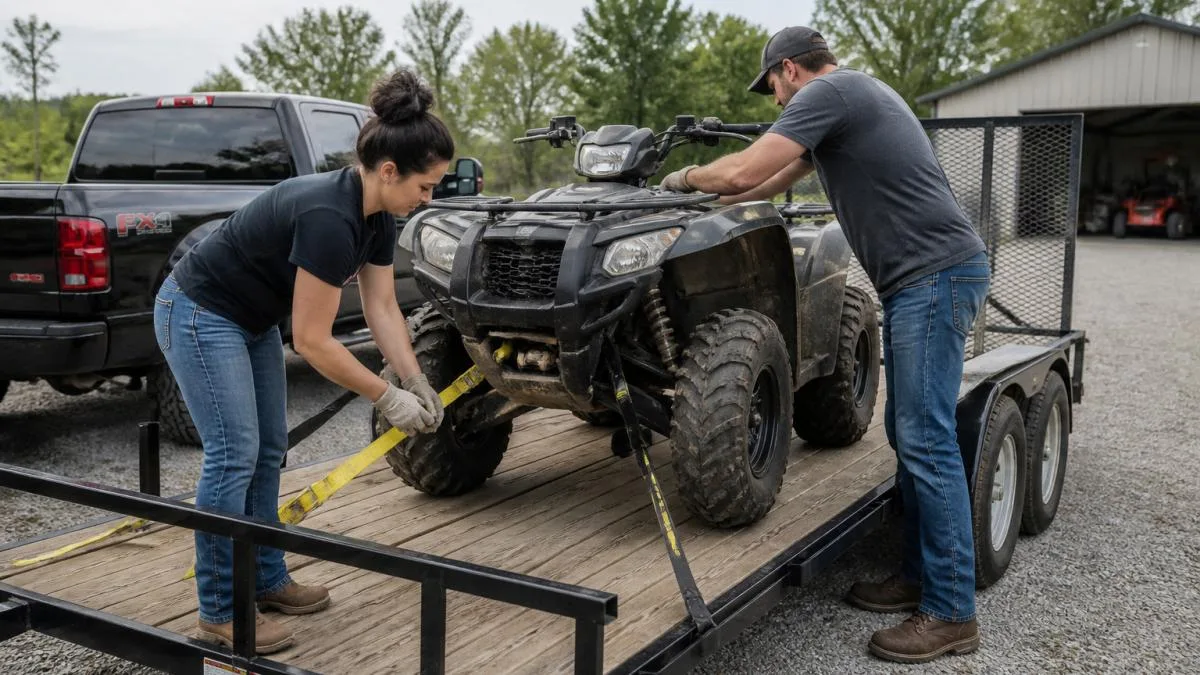
Work through these steps:
- Drive the ATV up the ramp slowly and center it on the deck.
- Set the parking brake or engage gear, then turn the engine off.
- Attach ratchet straps to the frame or designated tie-down points, not the handlebars or plastic bodywork.
- Tighten the front straps and rear straps evenly, then check tension again after a few miles.
Motorcycle Trailer Tie-Down Points and Load Securement
Motorcycles need tie-down points that hold the bike upright without stressing the forks or wheels. Use wheel chocks or a dedicated motorcycle tie-down system, and strap the frame or triple clamps rather than the handlebars.
Keep straps snug but not overtightened, since excessive force can damage suspension components. Recheck every stop on longer trips, because vibration can loosen connections over time.
Choosing the Right Trailer for Your Hauling Needs
Start with what you carry most often, whether that is a single atv and motorcycle trailer setup or a larger mixed load. If you haul one motorcycle occasionally, a folding trailer may be enough. If you move two ATVs or a mix of vehicles, a utility trailer with a longer deck and higher payload gives you room to grow.
Match the trailer to your tow vehicle, confirm the rated payload, and plan for the weight of gear you add later. Ready to compare options? Shop trailers at True North Trailers and Equipment to find the trailer that fits your vehicles and your budget.
Frequently Asked Questions
What type of trailer is best for hauling an ATV and a motorcycle?
An open utility trailer is the most versatile choice for hauling both an ATV and a motorcycle. It gives you room to load a wide ATV without tight clearance, and ramps or a low deck make loading easier. Enclosed trailers protect vehicles from weather and road debris but cost more and weigh more. If you mostly haul on rough ground or need quick access, an open trailer with a solid deck and secure tie-down points is usually the practical pick.
Can one trailer carry both an ATV and a motorcycle?
Yes, a single trailer can carry both if its deck is long and wide enough and its weight rating covers both vehicles combined. A 6x12 utility trailer is often suited to two vehicles, while a larger deck gives more room to position them safely. Load the heavier ATV over the axle, place the motorcycle where it sits level, and confirm the combined weight stays within the trailer's rated capacity before every trip.
What size trailer do I need for an ATV and motorcycle?
For one ATV and one motorcycle, a trailer around 6 to 7 feet wide and 12 to 16 feet long is a common starting range. Measure your ATV's overall length and width, including handlebars and racks, then add clearance at both ends. Leave room for loading ramps and tie-downs. Choosing a deck slightly larger than your vehicles prevents pinching and makes securing them easier.
How much weight can an ATV or motorcycle trailer carry?
Trailer payload ratings vary by model, so check the manufacturer's stated capacity on the trailer's placard or specification sheet. Add the weight of your ATV, motorcycle, gear, and any fuel to estimate total load. Stay below the rated capacity with a margin for safety. Tongue weight also matters, so confirm your tow vehicle can handle both the trailer and the load.
