


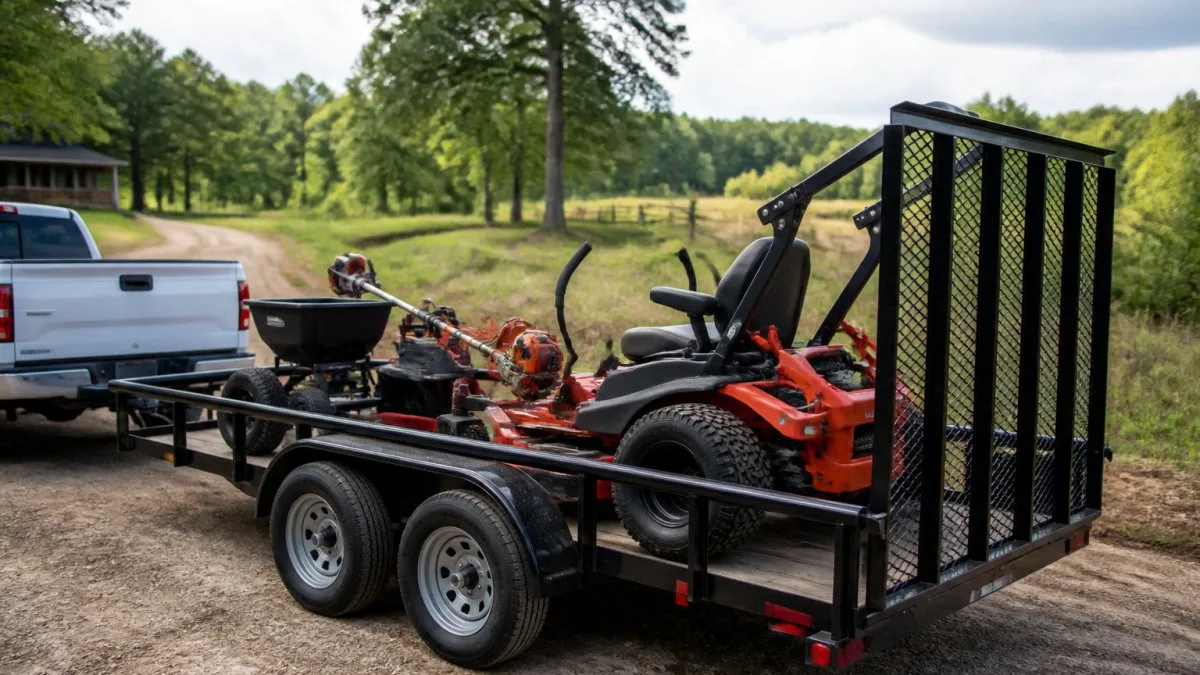
Quick Summary
The right what size trailer for acreage maintenance depends on three things: the equipment you haul, how far and how often you haul it, and what your tow vehicle can safely pull. Match the trailer to your largest machine first, then check payload and tongue weight. Most property owners with a zero-turn mower use a 6x10 or 6x12 utility trailer.
- Measure the full footprint of your largest machine and add 12 to 18 inches of clearance front and rear.
- Calculate payload as GVWR minus the trailer's curb weight, not from GVWR alone.
- Aim to load the trailer to about 80 to 90 percent of its payload for regular hauling.
- Keep tongue weight at roughly 10 to 15 percent of the loaded trailer weight and confirm your hitch rating.
- Choose tandem axles for compact tractors and heavier equipment, since they add capacity and stability.
Table of Contents
- Matching Trailer Size to Your Acreage and Equipment
- Utility Trailer Size for Riding Mower and Zero-Turn Mower Hauling
- Trailer Size for Compact Tractor and Larger Equipment
- Payload, GVWR and Tongue Weight: Calculating What You Can Safely Haul
- Open vs Enclosed Trailer for Lawn Equipment
- Loading, Securing and Transporting Your Equipment Safely
- Choosing Your Trailer: Next Steps With True North Trailers and Equipment
- Frequently Asked Questions
Last Updated: October 26, 2026
What Size Trailer for Acreage Maintenance: A Complete Guide
Picking the right what size trailer for acreage maintenance comes down to three things: what you haul, how far and how often you haul it, and what your tow vehicle can safely pull. Get any one wrong and you end up with a trailer that can't carry your mower or can't be towed safely.
This guide covers how to size a trailer for acreage work, from mower deck width and axle ratings to ramp compatibility.
Matching Trailer Size to Your Acreage and Equipment
Start with the equipment, then work backward to the trailer. The mower or tractor you haul sets the minimum deck and length, and the acreage you maintain sets how often that load moves.
How Acreage Size and Mowing Frequency Change Your Needs
Acreage maintenance is not one job. It is a mix of mowing, trimming, spraying, hauling soil or gravel, moving implements, and clearing debris, and the trailer has to handle the heaviest and bulkiest of those tasks. A weekly-mowed zero-turn property calls for a different trailer than one where a compact tractor with a loader moves between parcels twice a month. Use this framework to translate acreage and frequency into a trailer class:
- Under about 2 acres, one location, weekly mowing: a single walk-behind or small riding mower. A 5x8 or 5x10 utility trailer with a single 3,500-lb axle is usually enough, and the trailer may stay hitched for much of the season. You can browse cargo trailers for sale in the Louisiana area to compare sizes.
- About 2 to 5 acres, one or two locations, weekly to biweekly mowing: a zero-turn mower plus trimmers, fuel, and hand tools. A 6x10 or 6x12 utility trailer with a single 3,500-lb axle covers most setups; step to tandem 3,500-lb axles if you also haul a sprayer, aerator, or bagger.
- About 5 to 15 acres, multiple tasks, frequent implement changes: a sub-compact or compact tractor with a loader, mower, or box blade, plus a zero-turn. A 7x14 to 7x16 utility or equipment trailer with tandem 5,200-lb axles is the common starting point, and an 8.5x20 becomes relevant if you haul the tractor and an implement together.
Frequency matters as much as acreage. A trailer that moves once a month can be lighter and simpler; one that moves several times a week should have brakes on at least one axle, quality tires, and a deck height and ramp angle that make solo loading fast and safe.
Terrain and site access also shape the choice. Rolling ground, soft pasture, and gravel lanes favor ground clearance and a ramp that does not dig in, while tight gates favor a shorter trailer that backs easily.
Ask three questions before you shop: how many acres do I maintain, how often does equipment move between locations, and what is the single heaviest load I will ever put on the trailer? The answers push you toward a lighter utility trailer for occasional work or a heavier-duty model for daily hauling.
Write down your heaviest anticipated load, not your average load.
Trailer Dimensions and Common Size Options
Trailer sizes are listed as deck width by bed length, such as 5x8, 6x10, 6x12, or 7x16. Bed length determines whether your mower fits with room to spare; deck width determines whether the wheels and ramps line up.
Common options for mower work include:
- 5x8 to 5x10: compact trailers for a single walk-behind or small riding mower
- 6x10 to 6x12: the most common size for a zero-turn mower with a standard deck
- 7x14 to 7x16: room for a larger mower plus a trimmer, fuel, and tools
Choose the smallest trailer that fits your largest machine with clearance on all sides. Extra length adds weight, reduces maneuverability, and costs more to own.
Utility Trailer Size for Riding Mower and Zero-Turn Mower Hauling
Most landscape and property-maintenance buyers start here. A utility trailer is the workhorse for riding and zero-turn mowers, and sizing it correctly prevents the most common complaint we hear: the deck scrapes the ramp or the rear of the machine hangs off the end.
Matching Trailer Length to Mower Deck Width
Measure your mower's overall length with the operator seat or stand in place, then add roughly 12 to 18 inches of clearance at the front and rear. For more detail, see choosing the right trailer for your landscape mower.
A common mistake is measuring only the deck, which is narrower than the full machine. Measure the full footprint, including the steering wheel and any fuel tank that extends past the frame.
Ramp, Gate and Deck-Width Compatibility
- Ramp length and angle: a steep ramp can ground a low-clearance mower at the transition point
- Gate clearance: the drop-down gate should not interfere with the mower's rear wheels or hitch
- Ramp width: the ramp must be wide enough for both mower tires with margin for error
Trailer Size for Compact Tractor and Larger Equipment
Compact tractors and attachments change the calculation. A tractor with a loader or rear implement is heavier, taller, and often wider than a mower, and it needs a trailer rated for that weight with tie-down points that handle the load.
Payload, GVWR and Tongue Weight: Calculating What You Can Safely Haul
- GVWR (Gross Vehicle Weight Rating): the maximum loaded weight of the trailer itself, including cargo
- Payload capacity: the cargo weight the trailer can carry, calculated as GVWR minus the trailer's empty (curb) weight
- Tongue weight: the downward force the coupler places on the hitch, typically 10 to 15 percent of total trailer weight
To size a trailer, add up the weight of the heaviest equipment you'll haul, plus fuel, tools, and tie-downs. Then choose a trailer whose payload capacity exceeds that total with a margin. Running close to the rated limit strains tires, brakes, and axles and shortens component life.
A Worked Weight-Matching Method
- Weigh the load, don't guess it. Use the manufacturer's spec sheet for the machine's dry weight, then add fuel (gasoline is roughly 6 lb per gallon, diesel roughly 7 lb per gallon), attachments, and the weight of tools and tie-downs. A zero-turn that lists at 1,000 lb can easily become a 1,200-lb load with a full tank, a bagger, and a trimmer rack.
- Add the trailer's empty weight. The curb weight is on the trailer's certification label, usually on the tongue or left front of the frame. Payload is GVWR minus that curb weight, so a trailer with a 7,000-lb GVWR and a 2,000-lb curb weight carries about 5,000 lb of cargo.
- Compare load to payload with margin. Aim to stay at or below roughly 80 to 90 percent of payload for regular hauling. That margin absorbs the fuel, tools, and debris that always seem to ride along.
- Check tongue weight against the hitch. Tongue weight should land near 10 to 15 percent of the loaded trailer weight. A 5,000-lb loaded trailer wants roughly 500 to 750 lb on the ball. Confirm your hitch, ball mount, and receiver are rated for that, and that the tow vehicle's maximum tongue weight is not exceeded.
- Confirm the tow vehicle's ratings. The owner's manual lists maximum towing capacity and maximum tongue weight, and those numbers assume a properly equipped vehicle. Payload inside the truck, passengers, and cargo all count against the tow vehicle's own GVWR, so a truck loaded with tools and a crew can hit its limit before the trailer does.
- Check axle and tire ratings. Each axle has its own rating, and the tires have a load range. The lowest-rated component in the chain sets the real limit, so a trailer with a generous GVWR but marginal tires is not a heavy-duty trailer in practice.
Never size a trailer by GVWR alone. A high GVWR with a heavy curb weight can leave surprisingly little payload, and that is the number that actually determines what you can haul.
Tow-Vehicle Limits and Axle Ratings
Axle ratings matter too. A single-axle trailer is lighter and cheaper but has less stability and capacity. Tandem axles add load capacity and smoother towing for heavier equipment, though they cost more and add weight. For a mower, a single axle is often enough; for a compact tractor, tandem axles are usually safer.
The table below summarises the key weight terms and the sizing checks the article recommends.
| Item | Value | Note |
|---|---|---|
| Gasoline weight | Roughly 6 lb per gallon | Add to load when fueled |
| Diesel weight | Roughly 7 lb per gallon | Add to load when fueled |
| Target load vs payload | 80 to 90 percent | Margin for fuel, tools and debris |
| Tongue weight | 10 to 15 percent of loaded trailer weight | Check against hitch rating |
| Payload | GVWR minus curb weight | Actual cargo capacity |
| Mower clearance | 12 to 18 inches front and rear | Added to overall machine length |
Open vs Enclosed Trailer for Lawn Equipment
Open and enclosed trailers both work for lawn equipment, and the right choice depends on how you use the machine and where you store it.
Open trailers are lighter, cost less, and are easier to load from the side. They expose equipment to weather and road debris, so they suit operators who store machines in a shed or garage. Enclosed trailers protect equipment, keep tools and fuel out of sight, and can double as storage, but they weigh more, cost more, and reduce the usable payload for a given tow vehicle.
Storage, Parking and Maneuverability Trade-offs
Trailer length affects where you can park and store it. A 20-foot trailer needs significant driveway or yard space, and backing it into tight spots takes practice. Shorter trailers maneuver more easily on job sites and gravel lots but limit how much equipment you can carry at once. If you have no covered space, an enclosed trailer may sit out in the weather regardless, which makes an open trailer with good tires and a tarp a practical alternative.
Loading, Securing and Transporting Your Equipment Safely
Good sizing only helps if the load stays put. Secure every machine with ratchet straps or chains anchored to the trailer's tie-down points, not to fenders or the deck.
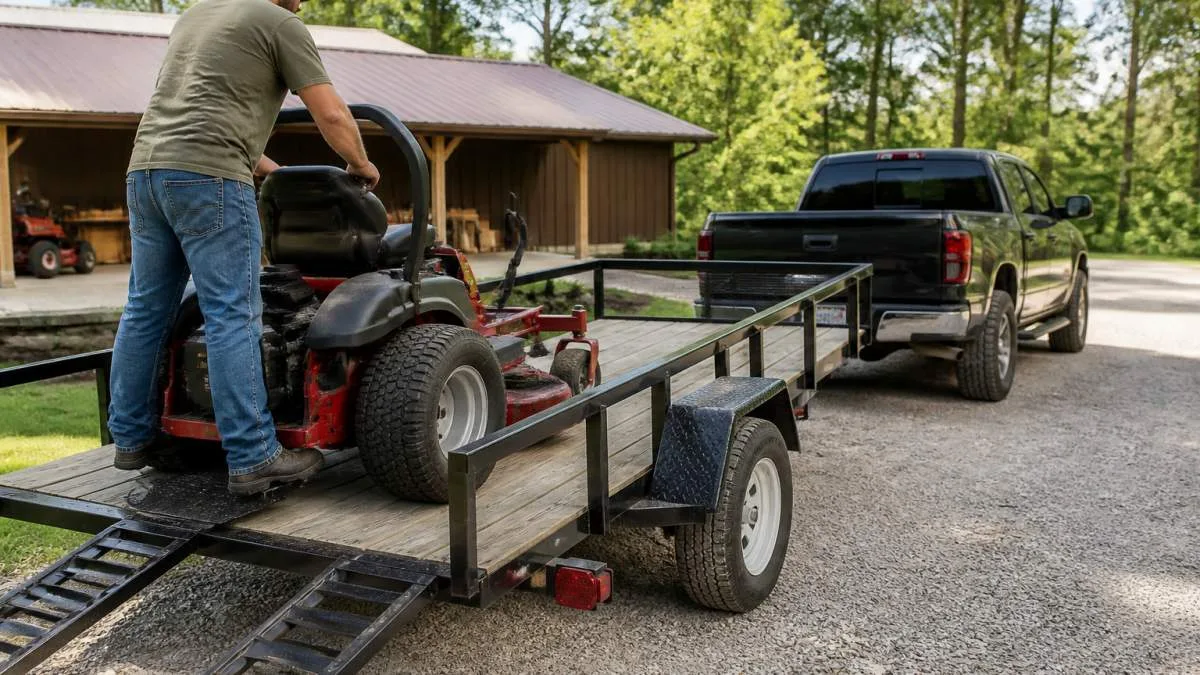
Before each trip, check tire pressure, lights, brakes, and the safety chains. Recheck the straps after the first few miles, since they can loosen as the load settles. Drive slower than you think you need to, leave extra stopping distance, and take turns wide.
A typical loading sequence:
- Confirm the ramp is locked and the gate is secured before pulling forward
- Drive the machine up slowly and straight, keeping a steady throttle
- Center the machine over the axle and set the parking brake or chock the wheels
- Strap the front and rear, then cross-tie for lateral stability
- Walk around the trailer and recheck every strap before departure
Choosing Your Trailer: Next Steps With True North Trailers and Equipment
Sizing a trailer for acreage maintenance comes down to matching your largest machine, your tow vehicle's limits, and your real hauling frequency. Measure your equipment, add up the weights, confirm your tow vehicle's ratings, and then choose the trailer that fits with margin on all three.
Once you have your numbers, browse our Utility Trailers For Sale in Louisiana area, Gooseneck Trailers For Sale in Louisiana area, or contact us at 318-446-3637.
Frequently Asked Questions
What size trailer do I need for a riding mower and acreage tools?
For most riding mowers and zero-turn mowers, a utility trailer of 5 by 10 feet or 6 by 12 feet gives enough deck clearance and room for a few hand tools. Measure the mower's overall length and width with the deck lowered, then add at least 12 inches of space on each side for tie-downs and walking access. Larger acreage crews carrying a mower plus a trimmer or sprayer usually move up to a 7 by 16 foot trailer.
How do I calculate the trailer size needed for my equipment?
Start with the length and width of your largest machine, including attachments and the deck in its transport position. Add roughly 2 feet of length for the ramp area and loading clearance. Then total the combined weight of everything you plan to carry and compare it against the trailer's GVWR, keeping in mind that the trailer's own empty weight counts toward that limit. A worked example: a 1,200-pound zero-turn mower on a trailer with a 3,500-pound GVWR and a 1,000-pound empty weight leaves about 2,300 pounds of payload.
How much payload capacity should a trailer have for acreage maintenance?
Payload capacity is the GVWR minus the trailer's empty weight. For a single zero-turn mower and light attachments, a trailer with at least 2,000 pounds of payload is a practical minimum. A compact tractor with a loader or implements typically needs 5,000 pounds or more of payload, and a tandem-axle trailer is the safer choice at that weight. Always keep total loaded weight under the tow vehicle's rated towing capacity, and confirm tongue weight is roughly 10 to 15 percent of the loaded trailer weight.
Is an open or enclosed trailer better for acreage maintenance?
An open trailer is usually the better choice for mowers and tractors because it is lighter, costs less to buy and maintain, and makes loading with a ramp straightforward. An enclosed trailer protects equipment from weather, theft and road debris, which matters if you store tools on it between jobs. Many operators who haul fuel-powered mowers prefer an open trailer and keep tools in a separate lockable box.
What trailer features make loading acreage equipment safer?
Look for a low deck height, which reduces the ramp angle, along with a ramp rated for the full weight of the heaviest machine, non-slip decking and secure tie-down points rated for the load. A tandem axle adds stability during loading, and a gate or beaver-tail design gives a flat approach for walk-behind equipment. Always use ratchet straps or chains rated above the equipment weight, and check the tie-downs before each trip.
