


Table of Contents
- Assess Your Mower and Load Requirements
- Best Trailer Size for a Zero-Turn Mower
- Landscape Trailer Weight Capacity Explained
- Open vs. Enclosed Landscape Trailer: Which Fits Your Business
- Single-Axle vs. Tandem-Axle Trailers
- How to Load a Riding Mower onto a Trailer Safely
- Choosing the Right Trailer for Landscape Mower Operations
- Frequently Asked Questions
Last Updated: October 21, 2026
Assess Your Mower and Load Requirements
Choosing the right trailer for a landscape mower starts with understanding exactly what you're hauling. Most landscapers underestimate their load before buying, then discover their trailer can't handle the job. The solution is simple: measure first, then select.
Measure Your Mower Dimensions
Your mower's footprint determines the minimum trailer deck size you need. Measure the length, width, and height of your landscape mower in its operating position. Most zero-turn mowers range from 48 to 72 inches wide and 36 to 48 inches deep. Height varies depending on the mower model, but account for an extra 12 inches above the seat for loading clearance.
Write these numbers down. You'll need them to calculate whether a 6x12 trailer works or if you need something larger. A common mistake is guessing dimensions instead of measuring. One landscaper assumed his 60-inch zero-turn mower would fit a 6-foot-wide trailer. It didn't. He wasted a weekend returning equipment.
Calculate Total Weight: Mower Plus Materials
Your landscape mower trailer needs to handle the mower weight plus whatever materials you're hauling. A typical zero-turn mower weighs 500 to 900 pounds. Add mulch, stone, or debris, and your total load grows quickly. A cubic yard of mulch weighs roughly 400 to 600 pounds. Stone is heavier, up to 1,500 pounds per cubic yard.
Write down:
- Mower weight (check the manufacturer specs)
- Materials you typically haul in one trip
- Total combined weight
This total determines your payload capacity requirement. If you're hauling a 700-pound mower plus 800 pounds of mulch, you need a trailer rated for at least 1,500 pounds of payload. Most trailers can carry more, but knowing your actual load prevents overloading, which damages the trailer and creates safety risks on the road.
Best Trailer Size for a Zero-Turn Mower
Trailer size directly impacts how efficiently you work. Too small, and you make extra trips. Too large, and you're towing unnecessary weight. The right size matches your mower and typical load.
6x12 and 6x14 Trailers for Solo Operators
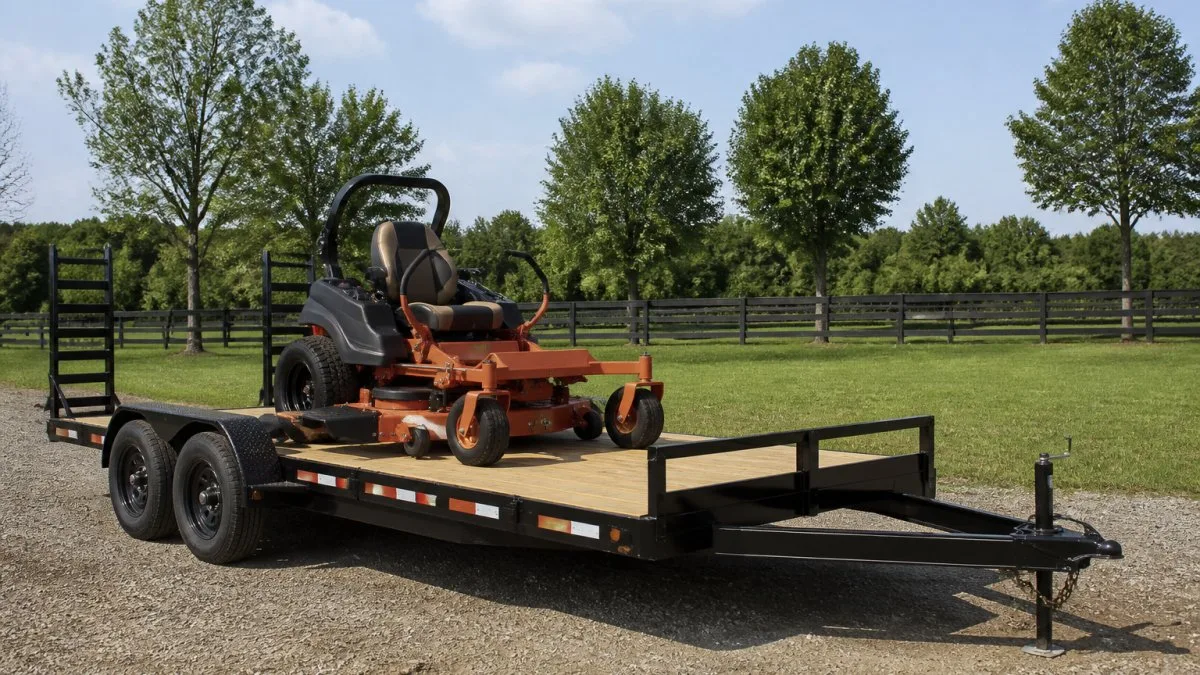
A 6x12 landscape mower trailer works well for solo landscapers with one zero-turn mower and light tool loads. The 6-foot width accommodates most mowers between 48 and 60 inches.
A 6x14 trailer adds 2 feet of length without much additional towing burden. You gain room for more materials or a second set of tools. Solo operators often choose 6x14 when they haul seasonal debris, leaves in fall, brush year-round, alongside their mower.
Both sizes typically feature single-axle construction, which is lighter and more maneuverable than tandem-axle options. Single-axle trailers are easier to back up and require less towing power. The trade-off is lower payload capacity compared to tandem-axle models.
14-Foot and 16-Foot Trailers for Crews and Multiple Mowers
Crews hauling multiple mowers or larger equipment need more space. A 14-foot trailer accommodates two zero-turn mowers side by side or one mower plus significant material volume. A 16-foot trailer handles even larger loads or multiple pieces of landscaping equipment.
These larger trailers often come with tandem-axle configurations, which distribute weight across four wheels instead of two. Tandem-axle trailers carry heavier loads and provide better stability on the road, especially when fully loaded.
What most guides miss is that crew operations benefit more from enclosed 14-foot or 16-foot trailers. Weather protection keeps equipment dry and secure, which matters when you're investing in multiple mowers and tools.
Landscape Trailer Weight Capacity Explained
Weight capacity numbers confuse many buyers. Understanding payload capacity, gross vehicle weight rating, and tongue weight prevents costly mistakes and unsafe loading.
Payload Capacity vs. Gross Vehicle Weight Rating
Payload capacity is the maximum weight your trailer can carry, mower, materials, fuel, everything. Gross vehicle weight rating (GVWR) is the maximum total weight the trailer can safely support, including the trailer itself.
Here's the difference: A trailer might weigh 1,200 pounds and have a GVWR of 3,500 pounds. That means your payload capacity is 2,300 pounds (3,500 minus 1,200). If you load 2,400 pounds into it, you've exceeded the GVWR and created a safety hazard.
Check your trailer's specification plate, it lists both numbers. Many landscapers ignore GVWR and load by feel. That's how trailers fail on the highway.
Tongue Weight and Towing Limits
Tongue weight is how much downward force the trailer places on your tow vehicle's hitch. Tongue weight typically runs 10 to 15 percent of total trailer weight.
Your tow vehicle has a maximum tongue weight rating. Exceed it, and you risk hitch failure and loss of control. Check your vehicle's owner manual for this spec, it's usually between 300 and 500 pounds for trucks and SUVs.
Towing capacity is separate from tongue weight. Your vehicle has a maximum towing capacity (often 3,500 to 10,000 pounds depending on the truck). You must stay within both limits: tongue weight AND total towing capacity.
Open vs. Enclosed Landscape Trailer: Which Fits Your Business
The choice between open and enclosed trailers shapes your workflow, maintenance costs, and professional image. Each serves different business models.
Open Trailers: Cost, Versatility, and Weather Exposure
Open trailers cost less upfront and offer maximum flexibility. You can haul oversized equipment, stack materials high, and load or unload quickly without worrying about clearance. Open trailers work for landscapers who haul seasonal debris, bulk mulch, or odd-shaped equipment.
The downside is weather exposure. Rain soaks materials and equipment. Sun fades fabric and degrades rubber. Metal parts rust without protection. Over three to five years, weather damage adds up. Mower seats crack. Tool handles swell and split. Metal hinges corrode.
Open trailers also offer no security. Equipment visible from the road invites theft. Landscapers in high-theft areas often move to enclosed trailers specifically for this reason.
Enclosed Trailers: Protection, Security, and Professional Image
Enclosed trailers protect equipment from weather and theft. Your mower stays dry. Tools don't rust. Materials stay clean. Enclosed trailers also project a more professional image, clients see a well-maintained, secure operation instead of equipment exposed on an open deck.
The trade-off is cost and reduced flexibility. Enclosed trailers cost 40 to 60 percent more than comparable open models. Loading height is limited by the trailer's interior clearance. You can't haul oversized debris or stack materials as freely.
Enclosed trailers make sense for crews with multiple mowers, significant tool investments, or high-value equipment. They're also better for year-round operations where weather protection prevents seasonal damage.
Single-Axle vs. Tandem-Axle Trailers
Axle configuration affects payload capacity, maneuverability, and cost. The right choice depends on your typical load weight and where you operate.
Single-axle trailers have one axle supporting two wheels. They're lighter, easier to maneuver, and less expensive. Single-axle models work for solo landscapers hauling one mower and moderate materials.
Tandem-axle trailers have two axles supporting four wheels. They distribute weight across more wheels, allowing higher payload capacity.
The drawback is maneuverability. Tandem-axle trailers are longer and harder to navigate in tight spaces. They require more towing power.
For a landscape mower trailer, single-axle works for loads under 2,500 pounds.
How to Load a Riding Mower onto a Trailer Safely
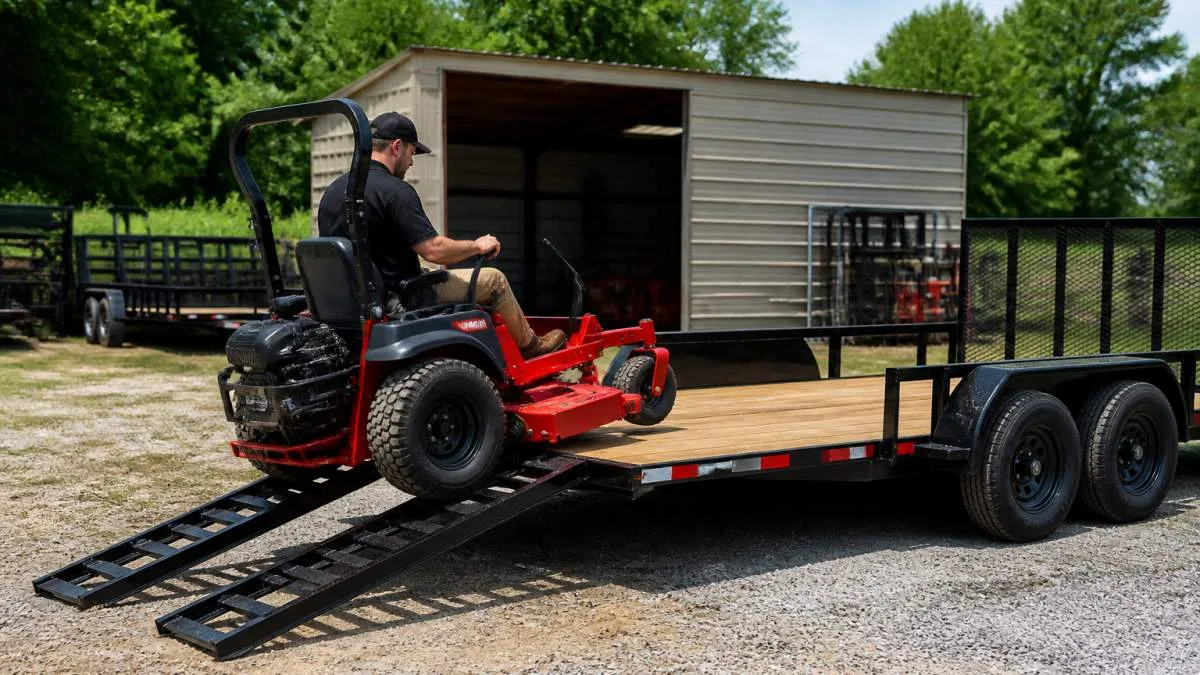
Safe loading prevents equipment damage and personal injury. The process requires proper ramp angle, correct positioning, and secure tie-downs.
Ramp Angle and Deck Height Considerations
Ramp angle determines whether your mower can climb safely. A ramp angle steeper than 15 degrees risks tipping. Too shallow, and the mower's front end drags on the trailer deck, causing damage.
Calculate the angle: measure your ramp length and the height difference between ground and trailer deck. Divide height by length, then multiply by 100 to get the angle percentage.
Most trailers sit 24 to 30 inches above ground. A longer ramp reduces the angle.
Before loading, check the mower's approach angle, the angle of the mower's front. Some zero-turn mowers have low front ends that catch on ramps. Drive slowly and watch for scraping.
Securing Your Mower with Tie-Downs
Tie-downs prevent the mower from shifting during transport. Use ratchet straps rated for at least the mower's weight.
Attach straps to the mower's frame, never to the seat or steering components. The frame is designed to handle load. Seats and steering parts are not.
Position straps at 45-degree angles when possible. This distributes lateral and vertical forces. Vertical-only straps don't prevent side-to-side movement. Diagonal straps keep the mower locked in place.
Check tie-downs before every trip. Movement during transport can loosen straps. A mower that shifts during braking can slide forward and damage the trailer deck or the mower itself.
Choosing the Right Trailer for Landscape Mower Operations
The best landscape mower trailer matches your equipment, load, and business model. True North Trailers and Equipment offers trailers in multiple sizes and configurations to fit different operations.
Matching Trailer Features to Your Workflow
Start by listing what you haul: one mower or multiple, seasonal materials or year-round loads, high-value equipment or basic tools.
Consider your typical workday. If you load and unload frequently, an open trailer saves time. If equipment sits exposed between jobs, an enclosed trailer protects your investment.
Also think about growth. If you're expanding from solo to a small crew, oversizing slightly now prevents buying a second trailer in two years. A 14-foot trailer costs more upfront but gives you room to add equipment without outgrowing it immediately.
New vs. Used: Durability and Cost Considerations
New trailers come with warranties and known maintenance histories. You control what happens from day one. Used trailers cost less but may have hidden issues. A trailer that looks good can have frame damage, bad welds, or worn brakes that fail unexpectedly.
When evaluating used trailers, inspect the frame for rust, cracks, or repairs. Check the welds, good welds are smooth and consistent. Test the brakes and lights. Ask for maintenance records.
True North Trailers and Equipment offers flexible financing to fit your budget. Our team helps you find the right fit for your operation and can answer questions about specific models and features.
Choosing the right landscape mower trailer determines whether your operation runs smoothly or struggles with equipment that doesn't fit your needs. True North Trailers and Equipment carries utility trailers in multiple configurations, open and enclosed, single-axle and tandem-axle, 6x12 through 16-foot lengths, with competitive pricing and flexible financing options.
Frequently Asked Questions
Will a 60-inch mower fit on a 6x12 trailer?
A 60-inch mower typically fits on a 6x12 trailer, but you need to account for the mower's length and the trailer's usable deck space after accounting for the tongue. Most 60-inch mowers are 48-52 inches wide and 60-72 inches long. A 6x12 trailer gives you 12 feet (144 inches) of length, leaving room for the mower and some tools, though space will be tight. Measure your specific mower before purchasing to confirm fit.
What is the best trailer size for a zero-turn mower and landscaping tools?
A 6x14 or 6x16 open utility trailer is ideal for a zero-turn mower plus hand tools and seasonal materials. The 6x14 suits solo landscapers with one mower; the 6x16 works better for small crews or multiple mowers. Check the trailer's payload capacity to ensure it handles your mower's weight plus mulch, stone, or leaf debris. Verify your tow vehicle's capacity matches the trailer's gross vehicle weight rating.
How much does landscape trailer weight capacity matter?
Weight capacity is critical for safety and legal compliance. Payload capacity tells you how much cargo you can load; gross vehicle weight rating (GVWR) is the maximum total weight the trailer can safely carry. Exceeding these limits risks brake failure, tire blowouts, and violates federal transportation regulations. Add your mower weight, tools, and materials (mulch can weigh 1,000+ pounds per load), then choose a trailer with sufficient capacity plus a 20% safety margin.
Should I choose an open or enclosed trailer for my landscaping business?
Open trailers cost less and offer flexibility for oversized loads, making them popular for hauling mulch, stone, and debris. Enclosed trailers protect equipment from weather and theft, project a professional image, and reduce rust and wear on your mower. Choose open if you prioritize budget and versatility; choose enclosed if you want equipment protection and a polished business appearance. Consider your typical cargo and climate when deciding.